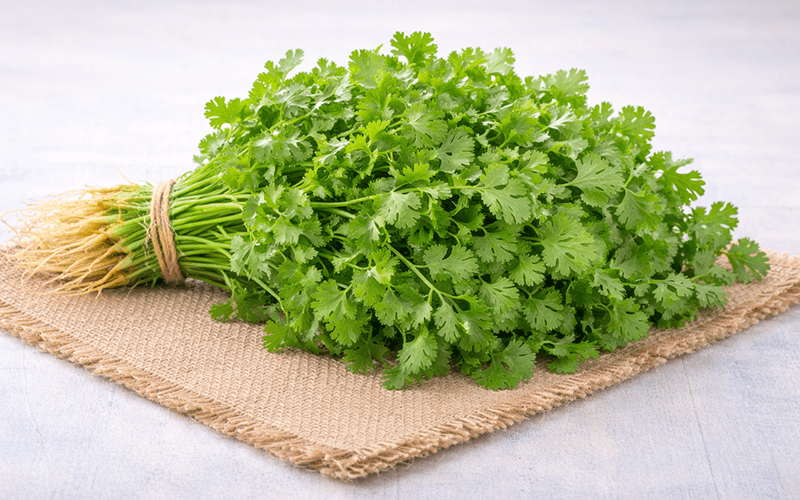
We are a Surat-based fresh vegetable exporter specialising in the worldwide export of fresh coriander leaves (cilantro). Coriander (Coriandrum sativum) known as dhania in Hindi, kothimbir in Marathi and kothamalli in Tamil, and sold as cilantro across the Americas is one of the most widely used culinary herbs in the world. We source premium coriander greens directly from progressive farms in Gujarat and surrounding belts and deliver them to bulk buyers worldwide.
Our supply chain is built around one simple promise: coriander leaves that are fresh, clean, aromatic and undamaged, harvested daily, uniformly sorted and packed to meet international quality, phytosanitary and packaging standards delivered consistently, shipment after shipment.
About Coriander Leaves Export from India
Coriander belongs to the Apiaceae family, along with parsley, carrot and dill, and its tender young leaves are used fresh in curries, chutneys, salads, soups, salsas and garnishes across cuisines worldwide. India is the world’s largest producer, consumer and exporter of coriander: according to the National Horticulture Board (NHB), India produced around 836,540 tonnes of coriander (seed spice) in 2023–24, led by Madhya Pradesh, Gujarat and Rajasthan. India also ranks second in the world in vegetable production after China (FAO/APEDA), and fresh coriander leaves are cultivated on a very large scale across the country’s vegetable belts.
Fresh coriander leaves are prized for their bright green colour, citrusy, slightly tangy aroma and tender texture. That steady global demand led by the Gulf countries, the United Kingdom, the United States, Canada, Singapore, Malaysia, the Maldives and several European markets makes India a natural and reliable source for wholesale coriander greens, especially for the large overseas South Asian diaspora.
Health Benefits & Nutritional Profile of Coriander Leaves
Fresh coriander leaves are remarkably low in calories yet rich in vitamins and plant minerals, which is one reason they remain popular in health-conscious diets. The values below are for raw coriander (cilantro) leaves per 100 grams, based on USDA FoodData Central (SR Legacy).
| Nutrient | Amount per 100 g | Approx. % Daily Value |
| Energy | 23 kcal | 1% |
| Protein | 2.13 g | 4% |
| Total fat | 0.52 g | 1% |
| Carbohydrate | 3.67 g | 1% |
| Dietary fibre | 2.80 g | 10% |
| Calcium | 67 mg | 5% |
| Iron | 1.77 mg | 10% |
| Magnesium | 26 mg | 6% |
| Potassium | 521 mg | 11% |
| Vitamin C | 27 mg | 30% |
| Vitamin A (RAE) | 337 µg | 37% |
| Folate | 62 µg | 16% |
| Vitamin K (phylloquinone) | 310 µg | 258% |
Exceptionally Rich in Vitamins A, C and K
A single 100 g serving of raw coriander leaves provides around 258% of the daily value for vitamin K important for normal blood clotting and bone health along with about 37% of the daily value for vitamin A and 30% for vitamin C. The leaves also supply vitamin E, folate and beta-carotene, plus the eye-supporting antioxidants lutein and zeaxanthin. (USDA FoodData Central.)
Good Source of Fibre and Plant Minerals
With around 2.8 g of dietary fibre per 100 g and useful amounts of potassium, iron, calcium and magnesium, coriander leaves support everyday digestion and a balanced, plant-rich diet. They are naturally low in calories (about 23 kcal per 100 g) and contain very little fat, making them an easy, flavourful addition to health-conscious menus. (USDA FoodData Central; WebMD; Healthline.)
A Traditional Herb for Digestion and Detoxification
Coriander leaves have been used in Ayurveda and other traditional medicine systems for centuries, mainly as a mild digestive and detoxifying herb. Modern nutrition research highlights their antioxidant content including flavonoids and phenolic compounds which is associated with general wellbeing. These benefits are best understood as part of a balanced diet rather than as medicinal claims. (WebMD; Healthline.)
Why Choose Indian Coriander Leaves for Export?
Round-the-Year Cultivation
Coriander can be sown several times a year across India’s different agro-climatic regions, and the leaf crop is ready for its first harvest within roughly a month of sowing. This staggered, multi-crop pattern gives India dependable year-round supply a strong advantage for buyers who want steady weekly or monthly volumes rather than seasonal spikes.
India’s Strength as the World’s Largest Coriander Producer
India is the world’s largest coriander producer, consumer and exporter, with deep cultivation expertise in both the leaf and seed crops (NHB; Spices Board India). Madhya Pradesh, Gujarat and Rajasthan together account for most of the country’s coriander output, supported by efficient wholesale markets and well-developed fresh-produce logistics.
Competitive Pricing and Steady Supply
Favourable land and labour costs, high-yielding varieties and efficient mandi networks combine to keep Indian coriander highly competitive on price. For wholesale importers, this translates into better margins without compromising on freshness.
Distinctive Aroma and Strong Cold-Chain Performance
Indian coriander greens are known for their bright green colour, tender leaves and characteristic citrusy aroma. While fresh herbs are naturally perishable, properly pre-cooled and cold-chain-managed coriander retains its colour, crispness and aroma over long-haul air and sea routes a key requirement for export buyers. Research by the UC Davis Postharvest Technology Center shows cilantro can maintain good visual quality for 18–22 days at 0°C, with its characteristic aroma best preserved within the first 10–14 days.
Quality Standards & Sourcing
Every consignment of our fresh coriander leaves passes through strict sorting, washing and quality checks before packing. We discard damaged, bruised, yellowed or sub-par produce so that only uniform, clean, high-quality leaves and bunches are shipped.
Direct Sourcing from Farms
We source directly from progressive local farmers across the Surat region of Gujarat, ensuring fresh daily harvests with zero delay between cutting and packing. This belt’s warm, semi-arid climate suits coriander well, and farm-direct buying lets us control quality from the field onward.
Sorting, Grading & Quality Checks
- Manual sorting and grading for uniform bunch size, leaf colour and freshness.
- Washing and removal of foreign matter, yellow and damaged leaves.
- Weight, moisture and aroma verification before packing.
- Documentation of phytosanitary compliance for export consignments.
Production Hubs & Trade Details
Major Producing States
Coriander is grown commercially in most Indian states, but the strongest production hubs for export sourcing, based on National Horticulture Board (NHB) estimates for 2023–24, include:
- Madhya Pradesh India’s largest coriander-producing state (around 458,790 tonnes in 2023–24).
- Gujarat our home sourcing belt and the second-largest coriander producer (around 185,030 tonnes).
- Rajasthan a leading traditional coriander belt (around 96,910 tonnes).
- Assam among the country’s top coriander-producing states (around 34,470 tonnes).
- West Bengal consistent supply from eastern growing regions (around 16,620 tonnes).
Major Wholesale Markets
Our trade is anchored at the New Sardar Vegetable Market, Surat, Gujarat one of the region’s principal wholesale vegetable markets, where daily arrivals are graded, auctioned and distributed to buyers across India and export markets. Being based here gives us direct access to farm arrivals, live market prices and reliable logistics partners.
Our Export Process
We manage the complete export pipeline in-house, from farm to port, so that buyers receive exactly what they order. Our process is simple and transparent:
- Sourcing directly from farms or local mandi (market) arrivals.
- Manual sorting, grading, washing and quality verification.
- Packaging in ventilated plastic crates or cardboard cartons to protect the leaves during transit.
- Cold-chain logistics and customs clearance documentation, including phytosanitary certificates.
- Global shipment via air cargo or sea containers to the destination port.
Export Packaging & Cold Chain
Because fresh coriander is a highly perishable herb, packaging and temperature control decide how the produce arrives at your end. We follow the cold-chain parameters below throughout our supply chain.
| Parameter | Recommendation |
| Pre-Cooling | Immediately after harvest; forced-air pre-cooling or hydrocooling |
| Storage Temperature | 0°C to 2°C |
| Relative Humidity | 95–98% |
| Shelf Life | 10–14 days under proper refrigerated conditions |
| Transportation | Refrigerated reefer containers; air freight for urgent shipments |
We use:
- Ventilated plastic crates for short-haul and air freight consignments.
- Corrugated cardboard cartons with proper liners for sea freight.
- Pre-cooling immediately after packing to slow moisture loss.
- Temperature-controlled cold-chain handling from pack-house to port and during air or sea transit.
Market Price & Wholesale Inquiries
We offer competitive wholesale mandi rates that are updated daily based on New Sardar Vegetable Market, Surat price trends. Since coriander prices move with daily arrivals and seasonal demand, we encourage bulk buyers to contact us for today’s live rate and a quotation tailored to their volume, packaging and destination.
For importers, wholesalers, supermarket chains, food-service suppliers and food processors, we provide consistent monthly supply contracts, documented quality checks and reliable delivery schedules.
Frequently Asked Questions
What is the HS code for fresh coriander leaves?
Fresh coriander leaves (fresh cilantro) are generally classified under HS Code 0709.99 (other fresh or chilled vegetables), commonly reported as 0709 99 90 for fresh herbs and other vegetables. Buyers should confirm the applicable HS code with their customs agent, as classification can vary by importing country.
Which markets import fresh coriander leaves from India?
Key destinations include the Gulf countries (UAE, Saudi Arabia, Qatar, Kuwait, Bahrain and Oman), the United Kingdom, the United States, Canada, Singapore, Malaysia, the Maldives and European markets driven largely by South Asian diaspora demand and the growing global use of fresh cilantro in modern cuisines.
What is the shelf life of export-grade coriander?
Under a proper cold chain (0–2°C and 95% or higher relative humidity), fresh coriander typically maintains good quality for 10–14 days. UC Davis postharvest research shows cilantro can retain good visual quality for up to 18–22 days at 0°C, although its characteristic aroma is best enjoyed within the first 10–14 days.
Do you provide phytosanitary certification and export documentation?
Yes. Export consignments are supported with phytosanitary certificates issued by the designated plant quarantine authorities, along with commercial invoices, packing lists and other shipping documents, and our facility operates in line with APEDA export documentation requirements.
How do you keep coriander fresh during transit?
Leaves are pre-cooled soon after packing and moved through a temperature-controlled cold chain. For long distances we recommend air freight; reefer sea containers with proper cold-chain management are suitable for shorter transit windows.
What is the minimum order quantity (MOQ)?
We cater to bulk B2B orders. MOQ and pricing depend on the destination, packaging type and season. Contact our sales team with your requirement to receive a detailed quotation.
Contact Us for Bulk Wholesale Inquiries
Ready to add fresh Indian coriander leaves to your import portfolio? Write to us for today’s live wholesale rate, product specifications, packaging options and shipping quotes. Our team is based at the New Sardar Vegetable Market, Surat, Gujarat, and is always happy to help bulk buyers plan a reliable, long-term supply.
Sources & Verification Notes
Key figures on this page were verified against the following sources: India’s position as the world’s largest producer, consumer and exporter of coriander Spices Board India and APEDA; India’s position as the world’s second-largest producer of vegetables FAO and APEDA; state-wise coriander production (2023–24) National Horticulture Board (NHB), Ministry of Agriculture & Farmers Welfare; postharvest storage and shelf-life guidance for fresh coriander UC Davis Postharvest Technology Center and OMAFRA (Ontario Ministry of Agriculture, Food and Rural Affairs); and the nutritional profile of raw coriander (cilantro) leaves USDA FoodData Central (SR Legacy). Export destinations reflect published India fresh-vegetable and coriander export data (APEDA/DGCIS/Spices Board).