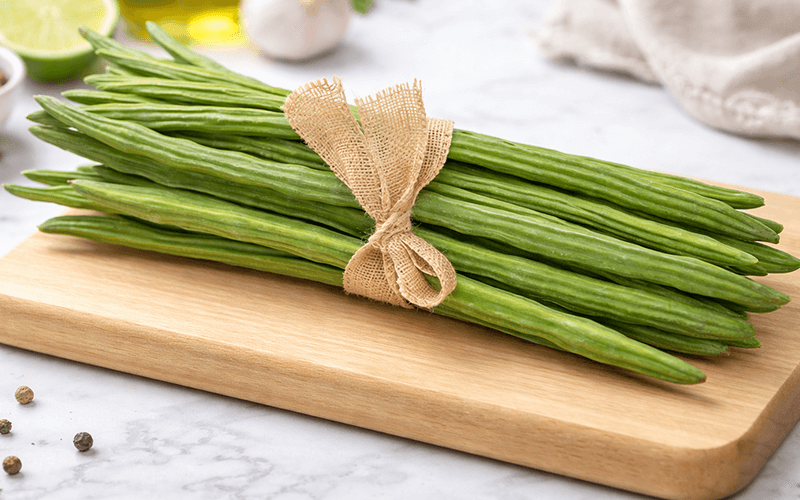
Fresh Drumstick (Moringa) Exporter from India Sardar Vegetable Market
Drumsticks the tender green pods of the Moringa oleifera tree are a staple of South Indian cooking and, increasingly, one of the world’s most talked-about healthy vegetables. In India they are sautéd into sambar, lentil and chutney preparations; in the Gulf and across the diaspora they appear in daily cooking; and in the UK, USA and Europe the same crop is being rediscovered as a nutrient-dense “superfood” in fresh, frozen and powdered forms. For an exporter, that adds up to a product with both dependable volume demand and a fast-growing premium segment.
Based in Surat, Gujarat, Sardar Vegetable Market is an established Indian exporter, wholesaler and supplier of fresh vegetables. For drumstick we operate a dedicated export line: farm-direct procurement from the southern belts where the best long-pod varieties grow, strict tenderness grading, rapid pre-cooling and air-freight dispatch so the pods arrive crisp and green. We blend the two faces of this market dependable fresh-pod volume for the Gulf and a certified, residue-clean programme for the UK and EU and we manage the entire chain from harvest to your airport.
Why India’s Drumstick Export Market Deserves Your Attention in 2026
Drumstick is a short-shelf-life crop where handling discipline decides everything. Get the cold chain right and it is a dependable repeat-order product; get it wrong and the consignment arrives soft, yellowed and worthless. Here is why India is the right source, and why we are the right partner.
- Production power: India is the world’s largest producer of drumstick pods, harvesting an estimated 1.1–1.3 million tonnes a year (Plants Journal review, 2024, citing Patel et al. 2015). No other country can match that scale, which is why India also runs the deepest network of export-ready sourcing and packing infrastructure for this crop.
- Active trade flows: India shipped roughly 4,742 drumstick consignments in the twelve months from October 2023 to September 2024, supplied by nearly 400 exporters to more than 600 buyers worldwide (trade-data tracking, ExportImportData).
- Where our fresh pods go today: The UAE, Qatar and the Maldives are the biggest fresh-volume destinations, driven by large South Asian communities. Singapore, Saudi Arabia, Malaysia, the UK and the USA complete the main demand base, with the UK and USA buying heavily in value-added form (powder, capsules, frozen).
- A growing export value: According to APEDA’s export reporting, the annual value of India’s moringa and drumstick-related exports exceeded US$55 million in 2023-24 spanning fresh pods plus the faster-growing value-added lines.
- Why buyers diversify to drumstick: The crop is rich in vitamin A, vitamin C, calcium, iron and antioxidants. As plant-based and functional-food trends spread, drumstick pods, powder and frozen cuts are being added to retail programmes from London to Dubai.
- Our strategy: We run two complementary lines dependable, volume fresh-pod supply for the Gulf under the India-UAE CEPA, and a residue-tested, fully documented programme for the UK and EU, where the India-UK CETA (in force since 15 July 2026) has removed tariffs on fresh vegetables. Because Gujarat itself is an emerging export-grade production hub, part of our supply is sourced close to home with short hauls to Mundra, Kandla and Nhava Sheva.
Our Sourcing Network & Harvesting Seasons
Drumstick is a warm-climate crop: annual varieties such as PKM-1 fruit roughly 6–8 months after planting, while semi-perennial and perennial trees crop in repeated flushes. By sourcing across several southern and western states with different growing windows, we keep export-grade supply continuous for most of the year.
Strategic Sourcing Clusters
Our procurement teams work directly with farmers and farmer producer organisations (FPOs) across India’s main drumstick belts:
- Tamil Nadu: Frequently cited as India’s production leader and home of the famous PKM-1 and PKM-2 varieties developed at Periyakulam. Belts around Coimbatore, Periyakulam and Salem supply our premium long-pod lines. The region’s airports handle a large share of fresh-pod air cargo.
- Andhra Pradesh: Records the largest area under drumstick in India (about 15,665 hectares), with strong volume in the March–June window and well-developed grading and packing infrastructure near the coast.
- Karnataka: India’s second-largest drumstick-growing state by area (about 10,280 hectares). The Bangalore–Hosur corridor is a proven air-cargo cluster for fresh pods and moringa leaves.
- Maharashtra & Gujarat: Emerging hubs for export-grade production. Maharashtra is close to Mumbai and Nhava Sheva airports, and Gujarat our home state gives us short hauls to the Mundra and Kandla port and airport corridors.
- Madhya Pradesh, Telangana & Odisha: Additional belts that add flexibility in off-peak windows and feed both fresh and processing demand.
Harvesting & Supply Calendar
By balancing regions and seasons, we maintain commercial supply across most of the calendar year:
| Sourcing Cluster | Peak Supply Window | Notes |
| Tamil Nadu (Coimbatore, Periyakulam, Salem) | February – June (annual); October – January (semi-perennial) | PKM-1 & PKM-2 home; frequently cited production leader |
| Andhra Pradesh | March – June | Largest area under drumstick in India (≈15,665 ha) |
| Karnataka (Bangalore–Hosur belt) | March – July | ≈10,280 ha; strong air-cargo cluster |
| Maharashtra | March – June / October – December | Near Mumbai & Nhava Sheva airports |
| Gujarat (our home base) | April – July | Emerging export-grade hub; short hauls to Mundra & Kandla |
These are indicative peak windows. Because drumstick is grown in overlapping regional seasons across annual, semi-perennial and perennial types, we can maintain commercial supply for most of the year.
Indian Drumstick Varieties We Supply
We select varieties for the qualities that matter in export: long, straight, tender pods that stay green and firm on the route to your market. These are the types we ship most often.
1. PKM-1
Our flagship export variety, developed at the Horticultural College and Research Institute, Periyakulam (Tamil Nadu). PKM-1 is a short-duration annual variety that fruits around 6–8 months after planting and produces straight, tender pods of good length. It is a proven performer under refrigerated storage controlled-atmosphere trials on PKM-1 extended pod shelf life to around 40 days at 14°C which makes it our default choice for export programmes.
2. PKM-2
A semi-perennial selection from the same Periyakulam programme, valued for its very long pods and heavy, repeated flushes across the season. PKM-2 is our preferred variety for volume orders where buyers specifically request long-pod lines.
3. Commercial & Local Long-Pod Types
Regional long-pod and “desi” types round out our sourcing. They are selected by belt, pod length and tenderness, and are typically used for Gulf volume programmes and short-sea routes where buyers are comfortable with slightly wider pod-length tolerance. Where a buyer requires a specific pod length, we confirm the available variety and grade before quoting.
Technical Specifications & Quality Standards
Every consignment we pack is graded against strict physical parameters so it clears the importing country’s plant health inspection and meets retail expectations for a fresh, tender pod.
Our B2B Quality Parameters
| Parameter | Specification |
| Pod length – Standard export | 50 cm – 75 cm, straight and tender |
| Pod length – Premium / long-pod | 75 cm – 100 cm+ (PKM-2 long-pod lines; buyer-specific) |
| Pod diameter | ≈ 1.5 cm – 2.5 cm, uniform and well-filled |
| Colour & appearance | Uniform green; smooth ridges; no yellowing, wrinkles, shrivelling or fibre |
| Tenderness | Pods snap cleanly and are free from fibre; harvested before fibre formation sets in |
| Defect tolerance | Maximum 1.5–2% cumulative tolerance for minor cosmetic marks; zero tolerance for mould, decay, softening or insect damage |
| Maximum Residue Limits (MRLs) | Drumstick is a residue-sensitive crop and a target of border inspections, especially for the EU; every batch is sampled and tested at APEDA-accredited / NABL laboratories before shipment, in line with each destination country’s limits |
Exact tolerances are set in the contract or specification sheet for each shipment and confirmed before packing.
Our Post-Harvest Handling & Packaging Process
Drumstick is one of the most perishable vegetables in the fresh produce trade at ambient temperature the pods keep only about 6 days before weight loss and decay set in, and marketability can drop below 40% by day 8. Our packing house follows a disciplined process from the moment the pods are cut.
Our Quality Assurance Steps
- Early Morning Harvest: Pods are cut in the cool early hours, with the stalk (pedicel) left on. Research on PKM-1 shows morning harvests with the stalk and a light calcium-chloride treatment hold quality far longer than afternoon harvests cut clean.
- Tenderness Grading: Pods are graded by length, diameter and tenderness. Over-mature pods which turn fibrous and tough are rejected at the farm gate.
- Field Heat Removal: Graded pods move quickly into pre-cooling to pull the field heat out and slow respiration before packing.
- Careful Packing: Pods are packed dry in ventilated cartons lined with HDPE to balance moisture retention with airflow the combination shown to give the longest refrigerated shelf life.
- Refrigerated Dispatch: Packed boxes travel in reefer trucks to the airport or port, never exposed to the sun on an open truck bed.
Important: The difference between a good and a lost drumstick shipment is field heat. Ambient-held pods keep only about 6 days at 25–28°C, while refrigerated pods at 10–12°C in HDPE packaging keep roughly 16 days (Journal of the Bangladesh Agricultural University study). Every hour of delay at the farm or on an open truck is cut out of that shelf-life budget.
Packaging Specifications
To protect the delicate pods and allow airflow, we offer:
| Format | Detail |
| Ventilated CFB cartons (HDPE-lined) | 5 kg, 7 kg and 10 kg net weights; printed with your brand and import details |
| Air-freight boxes | Lightweight, ventilated cartons with cushioned pods for short air transits |
| Rigid plastic crates | 10 kg – 15 kg crates for regional and short-haul routes |
Branded cartons with your logo and import details are available on request.
Cold Chain Logistics & Shipping Safety
Fresh drumstick is shipped almost exclusively by air, because even a well-run ocean voyage exceeds the pod’s natural shelf life. Our cold chain is designed around speed and a narrow temperature band.
Cold Chain Parameters
| Parameter | Setting |
| Set point (commercial air-freight transit) | +5°C to +8°C |
| Research-verified refrigerated storage | +10°C to +12°C extends shelf life to ≈16 days (HDPE-packed) |
| Ambient (no cold chain) | ≈6 days only; marketability below 40% by day 8 |
| Relative humidity | High keep pods turgid without condensation that triggers mould |
| Ventilation | Ventilated cartons with HDPE liner to balance moisture and airflow |
Transit practice and research-backed storage figures are shown separately; exact set points are confirmed per shipment based on route, season and packaging.
Warning: Warm loading is the fastest way to lose a drumstick shipment. Pods loaded warm into a reefer raise the temperature of the whole container, condensation forms on the packaging, and decay spreads quickly. Similarly, leaving pods in a sealed airtight carton without the HDPE liner invites moisture damage. We pre-cool, ventilate and load cold every time.
Temperature Data Loggers
Independent digital temperature loggers travel with every consignment and record temperature and humidity at regular intervals. The log is documented proof of the cold chain and the primary evidence for insurance claims or carrier compensation in the rare event of equipment failure.
Transit Times
For fresh pods we dispatch by air from Mumbai, Nhava Sheva, Bangalore, Coimbatore and Chennai: roughly 1–3 days to Gulf hubs such as Dubai and Doha, 2–4 days to Singapore and Southeast Asia, and 3–5 days to the UK and EU a window within which a pre-cooled, HDPE-packed pod still has 7–10 days of shelf life on arrival under ideal conditions. Sea freight is reserved for frozen pods and value-added moringa products, which do not carry the same urgency. Actual transit times vary with the carrier’s schedule and routing.
Export Compliance & Certifications
We handle customs clearance and export compliance in India so your shipment arrives without surprises.
Export Policy for Drumstick
Drumstick is freely exportable under the current Foreign Trade Policy there is no export licensing or quota restriction. What the trade does require is proper documentation, residue compliance and, for many destinations, a phytosanitary certificate.
HS / HSN Classification
| Product form | HS / HSN heading | Typical 8-digit lines |
| Fresh or chilled pods | 0709.99 other vegetables, fresh or chilled | 07099920 / 07099990 |
| Frozen pods | 0710.80.90 frozen vegetables | 07108090 |
| Fresh leaves | 1211.90.29 plants for food/flavouring | 12119029 |
| Dried powder (value-added) | 1211.90.99 dried plant material | 12119099 |
Classify by the exact product form shipped and confirm the current 8-digit tariff item in the ITC(HS) schedule before filing (see tariff note below).
Essential Documentation Checklist
Every drumstick shipment ships with a full document set:
- Import Export Code (IEC): Issued by the Directorate General of Foreign Trade (DGFT).
- APEDA Registration (RCMC): Registration-cum-Membership with APEDA, required for fresh vegetable exports.
- FSSAI License: Food Safety and Standards Authority of India registration.
- Phytosanitary Certificate: Issued by the Directorate of Plant Protection, Quarantine & Storage (DPPQS), confirming the consignment is free of quarantine pests.
- Residue Test Reports: From APEDA-accredited / NABL laboratories, confirming MRL compliance for the destination country.
- SGS / Intertek Quality Report: Pre-shipment inspection and residue analysis upon buyer request.
- Certificate of Origin: Required to claim preferential tariff benefits essential under the India-UAE CEPA and the India-UK CETA.
- Commercial Invoice & Packing List: Fully itemised commercial documents.
- Airway Bill / Bill of Lading: The contract of carriage for the shipment.
Note on 2026 tariff code alignment: Following the DGFT’s July 2026 harmonisation of the ITC(HS) 2022 Schedule with the Finance Act 2026 (Notifications No. 24/2026-27 for the import policy schedule and No. 26/2026-27 for the export policy schedule), exporters should always confirm the precise 8-digit tariff item in the current ITC(HS) schedule before filing. Fresh drumstick continues to be classified under heading 0709, with the subheading 0709.99 used for fresh or chilled “other vegetables.”
Our Secure B2B Payment Terms & Policy
We operate on secure, documented payment methods only. We do not export on credit, consignment or commission.
The Risks of Consignment/Credit Trade
Operating on consignment common in GCC wholesale markets exposes a supplier to delayed payments, heavy deductions and arbitrary price reductions based on alleged cargo damage. We avoid this exposure entirely by insisting on secure payment structures.
Accepted Payment Structures
- 30% Advance + 70% Against Shipping Documents: A 30% advance (T/T) to begin harvesting and packing, with the balance paid against scanned copies of the Airway Bill / Bill of Lading and shipping documents.
- Confirmed, Irrevocable Letter of Credit (L/C) at Sight: Accepted for contract-based, high-volume shipment programmes.
Why Partner with Sardar Vegetable Market for Indian Drumstick Sourcing?
Choosing us as your B2B drumstick supplier means working with a team that handles the whole chain:
- Farm-direct sourcing from India’s leading drumstick belts in Tamil Nadu, Andhra Pradesh and Karnataka, plus emerging hubs in Gujarat and Maharashtra.
- Strict pod-length, tenderness and colour grading against your specification sheet.
- A disciplined cold chain early-morning harvest, rapid pre-cooling and reefer-truck dispatch to your airport or port.
- Documented residue testing and full farm-to-packhouse traceability for the UK, EU and Gulf programmes.
- Complete export documentation, HS classification and customs clearance handled in India.
- Secure, documented payment terms no credit, consignment or commission risk.
- Customised FOB or CIF quotes delivered within 24 hours.
Market Trends Reshaping Drumstick Trade in 2026
1. The India-UK CETA Is Now Live
The India-UK Comprehensive Economic and Trade Agreement (CETA), signed in London on 24 July 2025, entered into force on 15 July 2026. The UK has removed duties on roughly 99% of Indian tariff lines, including fresh vegetables so fresh drumstick from India now enters the UK duty-free, with a Certificate of Origin to claim the preference. For a market that already buys heavily in fresh and value-added moringa form, this is a meaningful cost advantage for UK retail and import programmes.
2. EU Market Access Opens Up via APEDA Veg.Net
APEDA’s Veg.Net portal went live on 23 March 2026 to support exports of green chilli and drumstick to the European Union, with an advisory on sampling and analysis for these two products issued on 25 March 2026. The EU is a demanding market on residue limits, and the Veg.Net framework gives Indian exporters a defined route for certification, sampling and compliance exactly the kind of documented chain that wins premium EU buyers.
3. The Gulf Keeps Buying Fresh Volume
The UAE, Qatar and the Maldives remain the largest fresh-pod destinations, driven by the Indian diaspora and daily cooking. India already supplies the UAE under the India-UAE CEPA (in force since May 2022), and an India-GCC Free Trade Agreement covering Saudi Arabia, Qatar, Kuwait, Oman and Bahrain is under active negotiation with a target conclusion in 2026 which would ease access further across the biggest volume market for Indian drumstick.
4. Superfood & Value-Added Demand Diversifies the Basket
Beyond fresh pods, moringa powder, capsules and frozen cuts are the fastest-growing lines, with strong demand in the USA, UK, Germany, the Netherlands and Japan. For fresh exporters this matters in two ways: value-added buyers are natural customers for a documented, residue-clean supply chain, and the moringa “superfood” halo lifts demand and price points across all forms.
5. The Road to US$100 Billion
India has set an ambitious target of US$100 billion in agricultural exports by 2030 (with APEDA targeting US$55 billion of that), against 2025-26 agri exports of about US$53.1 billion. Drumstick and moringa products sit squarely within this push, supported by RoDTEP incentives, Duty Drawback and government assistance for pack houses, pre-cooling units and cold chains all of which keep our FOB and CIF pricing competitive for buyers.
Place Your Wholesale Order with India’s Trusted Drumstick Supplier
Whether you run a supermarket chain, wholesale market or food-processing unit, Sardar Vegetable Market offers a reliable, high-quality supply of fresh Indian drumstick at competitive prices. From farm-direct sourcing in the southern belts and Gujarat to a documented cold chain and air-freight dispatch, we make drumstick exports simple.
Request a Wholesale Quote today. Our B2B export desk will provide customised FOB or CIF pricing for your airport or port within 24 hours.
Frequently Asked Questions (B2B Drumstick Export)
Q1. What is the HS Code for exporting fresh drumstick from India?
Fresh or chilled drumstick pods are exported under heading 0709.99 other vegetables, fresh or chilled with 8-digit lines such as 07099920 or 07099990 depending on the tariff schedule. Frozen pods move under 0710.80.90, fresh leaves under 1211.90.29, and dried powder under 1211.90.99. Always confirm the current 8-digit tariff item before filing.
Q2. What is your Minimum Order Quantity (MOQ) for drumstick?
For fresh pods shipped by air we work from about 300–500 kg per consignment. For frozen pods and value-added lines we accept full 20-foot or 40-foot reefer containers by sea. Minimums are confirmed with the grade, pod length and destination at the quoting stage.
Q3. Why is pre-cooling drumstick so critical before shipping?
Drumstick has a very short natural shelf life: pods held at ambient temperature (25–28°C) keep only about 6 days, with marketability falling below 40% by day 8. Removing field heat quickly and holding 10–12°C in HDPE packaging extends shelf life to roughly 16 days in research trials, and our 5–8°C air-freight chain delivers 7–10 days of shelf life on arrival.
Q4. How long does fresh drumstick stay fresh under your cold chain?
Under ideal commercial conditions pre-cooling, refrigerated transport and air freight fresh drumstick keeps for roughly 7 to 10 days after arrival. Because we dispatch by air, the pod still has most of that window left by the time it reaches your market.
Q5. Do you ship fresh drumstick by sea?
No fresh drumstick is shipped almost exclusively by air, because the pod’s shelf life does not survive a 16–19 day ocean voyage. Sea freight is reserved for frozen pods and value-added moringa products, which travel in reefers without the same urgency.
Q6. Can we customise the weight and printing of the drumstick cartons?
Yes. We supply fully customised, ventilated CFB cartons (5 kg, 7 kg, 10 kg) with HDPE liners and printed with your brand name, logo and import details, plus rigid plastic crates for short-haul routes and lightweight air-freight boxes.
Q7. Do you export drumstick on a commission or credit basis to Dubai or Qatar?
No. We do not export on a commission, consignment or credit basis. Every shipment runs on secure advance T/T or an irrevocable L/C at sight.
Q8. What document verifies that the drumstick is free of quarantine pests?
Every shipment is inspected by plant quarantine officials in India, who issue a Phytosanitary Certificate verifying the cargo is free of quarantine pests. Residue test reports from APEDA-accredited / NABL laboratories accompany shipments to residue-sensitive destinations such as the UK and EU.
Q9. Does the India-UK CETA cover fresh drumstick?
Yes. The CETA, in force since 15 July 2026, removed duties on roughly 99% of Indian tariff lines including fresh vegetables. Fresh drumstick from India now enters the UK duty-free when accompanied by a valid Certificate of Origin.
Q10. How do we get a CIF price quote for our target destination?
Contact our export desk with your destination airport or port, required pod length and grade, packaging type and delivery schedule. We will send a detailed CIF quote within 24 hours.