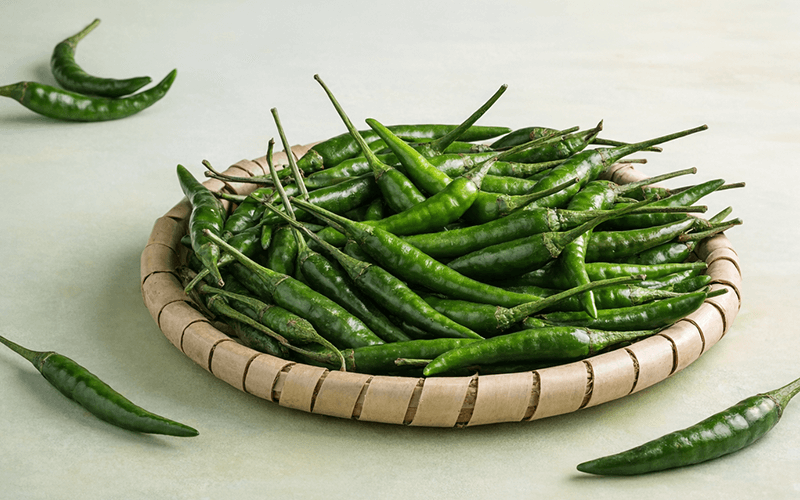
Fresh Green Chilli Exporter from India Sardar Market
Fresh green chillies (Capsicum annuum) are among the most indispensable ingredients in world cooking. From fiery curries in the Gulf to stir-fries in Southeast Asia and the growing “heat” trend in Western supermarkets, demand for clean, well-graded fresh chillies is strong and getting stronger. India is the world’s largest producer of chillies, harvesting more than two million tonnes a year, and one of the world’s leading exporters of fresh green chillies which means buyers get an unrivalled combination of volume, price and year-round availability.
Based in Surat, Gujarat, Sardar Market is an established Indian exporter, wholesaler and supplier of fresh vegetables. We run the whole chain ourselves farm-direct procurement from India’s leading chilli belts, strict size and heat grading, forced-air pre-cooling, and refrigerated delivery at your port. Our location is a genuine advantage for chilli buyers: Gujarat’s own Surat-Vadodara belt grows the famous Jwala variety destined for the UK, and we sit a short haul from Mundra and Nhava Sheva, two of India’s busiest container ports.
Why India’s Green Chilli Export Market Is Worth Your Attention in 2026
Green chilli is a high-turnover, margin-friendly commodity but only when the logistics are handled right. Here is why India, and our sourcing network in particular, is the right place to buy:
- Volume without limits: As the world’s largest chilli producer, India can commit consistent export quantities across every season.
- Year-round availability: Green chilli is a perennial crop, picked continuously across India’s diverse growing regions.
- Competitive FOB and CIF pricing: High production volumes and a short haul to western ports keep freight and landed costs low.
- Zero UK duty from 2026: The India-UK trade agreement, in force since 15 July 2026, removes duties on fresh vegetables.
- A compliance-ready chain: Documented residue testing and farm-to-packhouse traceability open the premium EU and UK markets.
Our Sourcing Network & Harvesting Seasons
Green chilli is a perennial in warm climates and can be picked continuously, which is why India can supply fresh chillies to the world in every month of the year. We build that year-round calendar by sourcing across several states.
Strategic Sourcing Clusters
Our procurement teams work directly with farmers and farmer producer organisations (FPOs) across India’s leading chilli-growing regions:
- Andhra Pradesh: The heart of Indian chilli. Our Guntur network delivers high-volume, high-pungency chillies from the Guntur-Prakasam-Krishna belt, the most important chilli cluster in the country.
- Telangana: The Khammam and Warangal belts are major sources of dark green, export-grade chillies that ship well on longer routes.
- Karnataka & Madhya Pradesh: Both rank among India’s top four chilli-producing states after Andhra Pradesh. Karnataka gives us long, dark green hybrids; Madhya Pradesh provides firm-skinned chillies that hold up well in transit.
- Maharashtra: The Solapur, Nashik, Aurangabad and Nandurbar belts are key sources of the G4 variety, and sit close to Nhava Sheva (JNPT) port, keeping inland transit short for westbound shipments.
- Gujarat (our home base): The Vadodara and Surat belts are famous for the Jwala variety destined for the UK market. Sourcing here means fresher produce and the shortest possible haul to Mundra and Nhava Sheva.
Year-Round Sowing & Harvesting Calendar
By balancing regions and seasons, we maintain commercial supply almost every month of the year. The table below shows the typical peak supply windows for each sourcing cluster.
| Sourcing Cluster | Peak Supply Window | Notes |
| Andhra Pradesh (Guntur–Prakasam–Krishna) | November – June | Kharif and rabi harvests; the largest year-round volume base |
| Telangana (Khammam–Warangal) | October – April | Dark green, export-grade pods |
| Karnataka | August – February | Long, dark green hybrids |
| Madhya Pradesh | November – January | Firm-skinned chillies for longer transit |
| Maharashtra (Solapur, Nashik, Aurangabad, Nandurbar) | May – October | G4 export window; Nandurbar picks up after August |
| Gujarat (Surat–Vadodara) | February – June | Jwala variety for the UK market |
These are indicative peak windows. Because chilli is a perennial crop, we cover gaps between windows through inter-seasonal production and controlled cold-chain storage, giving buyers commercial supply across all 12 months.
Indian Green Chilli Varieties We Supply
Different markets want different chillies a UAE buyer wants a dark, uniform, thick-skinned pod, while a UK buyer wants a specific slender finger chilli. Heat is measured on the Scoville scale, and we grade each variety for its intended destination.
1. G4 Green Chilli (Premium Export Variety)
Our primary export product and the preferred choice of Middle East importers. G4 produces bright, dark green pods of roughly 10–15 cm (4–6 inches) with a thick, glossy skin, medium-to-high pungency (commonly 30,000–50,000 SHU) and excellent uniformity. That thick skin is what makes it the default ocean-freight chilli it shrugs off handling and keeps its sheen over long voyages.
2. Jwala Green Chilli
India’s most famous finger chilli and our go-to variety for the United Kingdom. Jwala is slender, slightly curved and light green, with a fresh, grassy bite and high pungency. It is the variety UK importers ask for by name, and it is also the variety grown right on our doorstep in the Gujarat belts. For Jwala shipments we hold the chillies to strict pesticide residue limits and full farm-to-packhouse traceability.
3. Bhavnagri Chilli
A thick-walled, broad and famously mild green chilli from Gujarat, named after Bhavnagar. Bhavnagri is the choice for markets that want low heat it is the classic stuffing chilli and a favourite among buyers serving milder palates. Its size and mildness set it apart from the G4 and Jwala lines.
4. Kanthari (Bird’s Eye Chilli)
A small, intensely pungent chilli (Capsicum frutescens) grown mainly in southern India, with a heat rating of roughly 50,000–100,000 SHU the very top of our range. Kanthari is sought after by premium spice importers in Europe and Southeast Asia for its fierce heat and concentrated flavour, and it commands a significantly higher price per kilo.
5. Specialised Hybrids (Savitri, Agni Rekha, Volcano)
For contract buyers who need a precise colour index or exact heat level, we also supply selected hybrids such as Savitri, Agni Rekha and Volcano. These are grown under specific contracts to meet your specification sheet rather than an off-the-shelf standard.
Technical Specifications & Quality Standards
Every pod we ship is graded against international trade standards at our packing facility. Here are the parameters we work to:
Our B2B Quality Parameters
| Parameter | Specification |
| Variety | G4, Jwala, Bhavnagri, Kanthari or a specified hybrid |
| Size / length grading | Uniform per order; e.g. G4 graded at 10–15 cm |
| Colour | Uniform dark or light green; no yellowing |
| Pungency | Confirmed Scoville range per variety |
| Firmness | Mature, firm pods; no shrivelling |
| Blemish / damage tolerance | Typically up to 3–5% by weight |
| Immature / partially red pods | Up to 1–2% |
| Foreign matter | None |
| Free moisture | None in pack |
| Residue compliance | Meets destination-country MRLs; lab reports supplied |
| Shelf life at +7°C | 14–21 days from pre-cooling |
Exact tolerances are set in the contract or specification sheet for each shipment and confirmed before packing.
Our Post-Harvest Handling & Packaging Process
Fresh green chillies lose moisture and firmness quickly, so everything hinges on the hours between harvest and pre-cooling. Our packing house follows a disciplined process from the moment the pods are picked.
Our Quality Assurance Steps
- Early Morning Harvest: Pods are hand-picked in the cool early hours to keep field heat low. We harvest only mature green pods immature fruit shrivels, and partially ripened fruit turns red in transit.
- Sorting & Washing: Chillies are washed in cold, chlorinated water to remove field dirt and surface fungal spores, then dried with high-velocity air dryers so no free moisture is packed.
- Grading: Pods are sorted by size, colour and firmness to give you a uniform, retail-ready grade.
- Forced-Air Pre-Cooling: Packed cartons are placed in our pre-cooling chambers for 7 to 8 hours to bring the core temperature down to +7°C before loading.
- Export Boxing: Pre-cooled cartons are strapped and palletised, with temperature data loggers placed inside before the container is sealed.
Important: Skipping pre-cooling and loading warm chillies into a reefer is the single fastest way to lose a shipment. Warm pods raise the container temperature, condensation forms on the cartons, and the cargo can rot within days. We never load warm.
Export Packaging Specifications
We customise packaging to your market’s conventions. Standard options include:
| Specification | Detail |
| Carton | 5-ply corrugated fibreboard, ventilated / perforated |
| Liner | Food-grade LDPE inner liner |
| Common net weights | 4 kg, 6 kg and 10 kg (custom weights on request) |
| Palletisation | Standard 20-ft and 40-ft reefer pallet patterns |
| Loading capacity (40-ft reefer) | Approximately 3,700 cartons of 3.8 kg net |
| Labelling | Product, variety, net weight, packhouse UIC and traceability details |
Loading capacity varies with carton weight and container configuration; final counts are confirmed per booking.
Cold Chain Logistics & Shipping Safety
Green chilli is not a 0°C commodity. It is a warm-climate crop that suffers chilling injury at low temperatures, so the entire chain runs at a warmer set point than our leafy greens and that makes disciplined temperature control even more important.
Reefer Container Parameters
We ship in refrigerated (reefer) containers set to these parameters:
| Parameter | Setting |
| Set point | +7°C |
| Relative humidity | 90–95% |
| Fresh air exchange | Low (approx. 15–25 m³/hour) |
| Ventilation | Limited; maintained to minimise moisture loss |
| Temperature maintained | +7°C to +9°C throughout the voyage |
Warning: Below roughly +6–7°C, green chillies risk chilling injury watery spots and skin pitting that ruins the appearance. Above roughly +9–10°C, respiration speeds up, causing shrivelling, yellowing and decay. We hold the chain between +7°C and +9°C from pre-cooling to discharge.
Temperature Data Loggers
Independent digital temperature loggers inside every container record ambient temperature and humidity at hourly intervals throughout the voyage. The log is documented proof of the cold chain and the primary evidence for insurance claims or shipping-line compensation in the rare event of equipment failure.
Visual Audit & Container Seal Process
We photograph and record the full loading process container interior, pre-cooled cartons, loading arrangement, data logger placement and the final door seal and send the records to you before the vessel sails.
Transit Times From Our Ports
From Mundra or Nhava Sheva, expect roughly 4–7 days to Gulf ports such as Jebel Ali (Dubai), and around 16–19 days to the UK, with onward connections to Southeast Asia and East Africa. For premium, short-shelf-life orders we also ship by air freight from Mumbai. Actual transit times vary with the carrier’s schedule and routing.
Export Compliance & Certifications
We handle customs clearance and export compliance in India so your shipment arrives without surprises.
Essential Documentation Checklist
Every green chilli shipment ships with a full document set:
- Import Export Code (IEC): Issued by the Directorate General of Foreign Trade (DGFT).
- APEDA Registration (RCMC): Registration-cum-Membership with APEDA, required for fresh vegetable exports.
- FSSAI License: Food Safety and Standards Authority of India registration.
- Phytosanitary Certificate: Issued by the Directorate of Plant Protection, Quarantine & Storage (DPPQS), confirming the consignment is free of quarantine pests.
- Residue Test Reports: From APEDA-accredited / NABL laboratories, confirming MRL compliance for the destination country.
- SGS / Intertek Quality Report: Pre-shipment inspection and residue analysis upon buyer request.
- Certificate of Origin: Required to claim preferential tariff benefits essential under the India-UK trade agreement in force since July 2026.
- Commercial Invoice & Packing List: Fully itemised commercial documents.
- Bill of Lading (B/L) / Airway Bill: The contract of carriage for the shipment.
- EU Health Certificate & Veg.Net Traceability (EU shipments): Green chillies bound for the European Union require the EU health certificate issued by the competent authority, with farm-to-packhouse traceability recorded on APEDA’s Veg.Net portal.
Note on 2026 tariff code alignment: Following the DGFT’s July 2026 harmonisation of the ITC(HS) 2022 Schedule with the Finance Act 2026 (Notifications No. 24/2026-27 for the import policy schedule and No. 26/2026-27 for the export policy schedule), exporters should always confirm the precise 8-digit tariff item in the current ITC(HS) schedule before filing. Fresh green chillies continue to fall under heading 0709 (ITC(HS) 0709 60 10).
Our Secure B2B Payment Terms & Policy
We operate on secure, documented payment methods only. We do not export on credit, consignment or commission.
The Risks of Saturated Commission Markets (e.g., Dubai/UAE)
The Gulf fresh produce market is saturated, and many local agents push commission-based or consignment sales. For an exporter that means delayed settlement, heavy deductions and unfounded damage claims. We avoid this exposure entirely by insisting on secure payment structures.
Accepted Payment Structures
- 30% Advance + 70% Against Shipping Documents: A 30% advance (T/T) to begin harvesting and packing, with the balance paid against scanned copies of the Bill of Lading and shipping documents.
- 50% Advance + 50% Against Shipping Documents: A 50% advance (T/T), with the balance against scanned shipping documents our preferred split for air freight.
- 100% Advance Payment: Available, and recommended for rapid air freight shipments.
- Confirmed, Irrevocable Letter of Credit (L/C) at Sight: Accepted for contract-based, high-volume shipments.
Why Partner with Sardar Market for Indian Green Chilli Sourcing?
Choosing us as your B2B green chilli supplier means working with a team that handles the whole chain:
- Farm-direct sourcing from India’s leading chilli belts, including Gujarat, Andhra Pradesh and Telangana.
- Strict size, colour and heat grading against your specification sheet.
- A certified +7°C cold chain from forced-air pre-cooling to discharge at your port.
- Documented residue testing and full farm-to-packhouse traceability.
- Complete export documentation and customs clearance handled in India.
- Secure, documented payment terms no credit, consignment or commission risk.
- Customised FOB or CIF quotes delivered within 24 hours.
Market Trends Reshaping Green Chilli Trade in 2026
1. The India-UK Trade Agreement Is Now Live
The India-UK Comprehensive Economic and Trade Agreement (CETA), signed on 24 July 2025, entered into force on 15 July 2026. The UK has removed duties on roughly 99% of Indian tariff lines, including fresh vegetables. For green chillies where the UK is already one of our highest-value markets this means cheaper access to a premium buyer that has zero tolerance for pesticide residue and pays for quality.
2. The Gulf Is the Next Frontier
India already supplies the UAE and Gulf states under the India-UAE CEPA (in force since May 2022). An India-GCC Free Trade Agreement covering Saudi Arabia, Qatar, Kuwait, Oman and Bahrain is under active negotiation, with a target conclusion in 2026 which would further ease market access for the biggest volume market for Indian green chillies.
3. Residue-Tested & Traceable Is the Only Way Forward
Green chilli is among the most frequently flagged commodities at EU and UK borders for pesticide residue. Buyers are increasingly insisting on residue test reports, GAP-compliant farms and digital traceability such as APEDA’s Veg.Net portal. Exporters who can document a clean chain as we do win the premium markets.
4. Diversifying Away From a Single Market
Indian agri-exports grew 2.3% year-on-year in 2025-26 to about US$53.1 billion, despite US tariff measures between August 2025 and February 2026. Fresh fruit and vegetable exports continued to perform, with the UAE, Iraq, the Netherlands, Bangladesh and Malaysia among the leading destinations evidence that India’s market base is broadening.
5. The Road to US$100 Billion
India has set an ambitious target of US$100 billion in agricultural exports by 2030 (with APEDA targeting US$55 billion of that). Green chilli sits squarely within this push, supported by RoDTEP incentives, Duty Drawback and government assistance for pack houses, pre-cooling units and cold chains all of which keep our FOB and CIF pricing competitive for buyers.
Place Your Wholesale Order with India’s Trusted Green Chilli Supplier
Whether you run a supermarket chain, wholesale market, restaurant group or food-processing unit, Sardar Market offers a reliable, high-quality supply of fresh Indian green chillies at competitive prices. From farm-direct sourcing in Gujarat, Andhra Pradesh and beyond, to certified +7°C cold-chain delivery at your port, we make green chilli exports simple.
Request a Wholesale Quote today. Our B2B export desk will provide customised FOB or CIF pricing for your port within 24 hours.