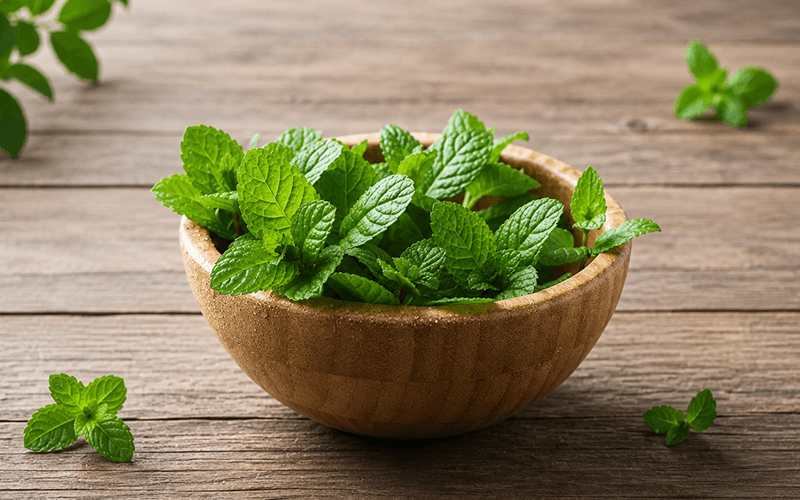
We are a Surat-based fresh vegetable exporter specialising in the worldwide export of premium fresh mint leaves (pudina). Mint (Mentha spicata, commonly called spearmint) is one of the most widely used culinary herbs in the world, valued for its bright green leaves, crisp texture and cool, aromatic flavour. We source clean, well-trimmed, high-grade mint directly from progressive farms and major producing belts across India and deliver it to bulk buyers worldwide.
Our supply chain is built around one simple promise: mint that is fresh, clean and uniformly bunched, harvested at the right stage, quickly pre-cooled and packed to meet international quality, phytosanitary and packaging standards, delivered consistently, shipment after shipment.
About Mint Export from India
India is the world’s largest producer of mint, and the country supplies about 80% of global demand for mentha (mint) oil, with roughly 40,000 tonnes of essential oil and menthol products produced every year. Mint cultivation covers about 300,000 hectares in India, concentrated mainly in the Indo-Gangetic plains of Uttar Pradesh, Bihar, Madhya Pradesh, Punjab and Haryana (CSIR, World Resources Institute).
Fresh mint is used in households, hotels, restaurants, beverage makers, food processors and the South Asian diaspora community worldwide. That steady global demand, led by the Gulf Cooperation Council countries, the United Kingdom and other European and Asian markets, makes India a natural and reliable source for wholesale mint.
Health Benefits & Nutritional Profile of Mint
Fresh spearmint is remarkably low in calories yet offers a distinct nutritional profile, and it is best known for the aromatic essential oils that give it its characteristic cooling taste. The values below are for raw spearmint per 100 grams, based on USDA FoodData Central (SR Legacy, FDC 173475).
| Nutrient | Amount per 100 g | Approx. % Daily Value |
| Energy | 44 kcal | 2% |
| Protein | 3.3 g | 7% |
| Total fat | 0.73 g | 1% |
| Carbohydrate | 8.4 g | 3% |
| Dietary fibre | 6.8 g | 24% |
| Calcium | 199 mg | 15% |
| Iron | 11.9 mg | 66% |
| Magnesium | 63 mg | 16% |
| Potassium | 458 mg | 10% |
| Copper | 0.24 mg | 27% |
| Manganese | 1.1 mg | 49% |
| Vitamin C | 13.3 mg | 15% |
| Folate | 105 µg | 26% |
A Rich Source of Iron, Folate and Vitamin C
A 100 g serving of raw spearmint provides around 66% of the daily value for iron, 26% for folate and 15% for vitamin C, along with 24% of the daily value for dietary fibre. It is also a notable source of calcium, magnesium and potassium. (USDA FoodData Central.)
A Good Source of Dietary Fibre
Fresh mint is surprisingly rich in fibre for a herb, providing about 6.8 g per 100 g, which is roughly a quarter of the daily value. Because mint is used as a flavouring, portions are typically small, but it still contributes useful fibre, vitamins and minerals when added to salads, chutneys, teas and cooked dishes.
Traditional Use for Digestion and Fresh Breath
Mint has been used for centuries in Ayurveda and other traditional systems, mainly to support digestion and to freshen the breath. The cooling sensation of mint comes from menthol, and these traditional uses are widely documented, though individual results vary and mint is best enjoyed as part of a balanced diet.
Why Choose Indian Mint for Export?
World’s Largest Mint Producer
India is the world’s largest producer of mint and the leading supplier of mentha oil, which gives exporters deep cultivation expertise, strong agronomy knowledge and a dependable supply base. Mint is harvested multiple times in a season, and the crop is grown across many states, so a healthy surplus is available for export.
Multiple Harvesting Seasons and Steady Supply
Fresh mint can be cut several times per season, and cultivation spans different agro-climatic belts, which smooths out seasonality. As a result, buyers can plan regular weekly or monthly shipments instead of one-time seasonal purchases.
Strong Aroma and Culinary Versatility
Indian mint is prized for its bright green colour, crisp leaves and high natural essential-oil content, which give it the strong, clean aroma that restaurants, juice bars and food processors look for. It works equally well in chutneys, salads, teas, beverages and garnishing.
Good Cold-Chain Performance for a Leafy Herb
Fresh culinary herbs such as mint hold their quality well when handled correctly. When pre-cooled and held at 0°C with relative humidity above 95%, fresh mint can maintain good quality for about 2 to 3 weeks, which supports dependable export shipping by air and short sea routes. (UC Davis Postharvest Research.)
Quality Standards & Sourcing
Every consignment of our fresh mint passes through strict grading and quality checks before packing. We select only bright green, freshly cut leaves and discard yellow, wilted, bruised or insect-damaged material, so that buyers receive uniform, export-grade produce.
Direct Sourcing from Producing Belts
We source directly from progressive farmers and reliable aggregators across India’s major mint belts, ensuring consistent quality and transparent supply. Sourcing close to producing regions shortens the gap between harvest and packing, which protects freshness and delivered weight.
Sorting, Grading & Quality Checks
- Manual sorting and grading by leaf size, colour and bunch uniformity.
- Removal of yellow, wilted, bruised or damaged leaves and foreign matter.
- Freshness, aroma and moisture verification before packing.
- Documentation of phytosanitary compliance for export consignments.
Production Hubs & Trade Details
Major Producing States
Mint is cultivated across most Indian states, and the strongest production hubs for export sourcing, based on CSIR and industry data, include:
- Uttar Pradesh: India’s leading mint-producing state, with roughly three-quarters of national mint output.
- Bihar: a key mint-growing state, especially around Madhepura district.
- Madhya Pradesh: a significant producer, especially of menthol mint.
- Punjab and Haryana: established mint belts of the Indo-Gangetic plains.
- Uttarakhand: contributes a smaller but valuable share of the national crop.
Gujarat, our home state, also contributes meaningful fresh mint volumes for regional and export supply, and our position at the Surat wholesale market gives us direct access to arrivals from all these belts.
Major Wholesale Markets
Our trade is anchored at the New Sardar Vegetable Market, Surat, Gujarat, one of the region’s principal wholesale vegetable markets, where daily arrivals are graded, auctioned and distributed to buyers across India and export markets. Being based here gives us direct access to farm arrivals, live market prices and reliable logistics partners.
Our Export Process
We manage the complete export pipeline in-house, from farm to port, so that buyers receive exactly what they order. Our process is simple and transparent:
- Sourcing directly from farms or local mandi (market) arrivals.
- Manual sorting, grading, trimming and quality verification.
- Packaging in ventilated cartons or food-grade poly bags to protect the leaves during transit.
- Cold-chain logistics and customs clearance documentation, including phytosanitary certificates.
- Global shipment via air cargo or refrigerated containers to the destination port.
Export Packaging & Cold Chain
Fresh mint is highly perishable and temperature is the single most important factor in keeping it fresh. We follow the cold-chain parameters below throughout our supply chain, based on UC Davis postharvest guidelines for fresh culinary herbs.
| Parameter | Recommendation |
| Pre-Cooling | Forced-air or room cooling to 0°C soon after harvest |
| Storage Temperature | 0°C (32°F) for optimum quality and storage life |
| Relative Humidity | Above 95% |
| Shelf Life | About 2 to 3 weeks at 0°C (about 2 weeks at 5°C) |
| Transportation | Refrigerated container or air freight held at 0°C |
We use:
- Ventilated plastic crates or food-grade poly bags for short-haul and air freight.
- Corrugated cardboard cartons with moisture-retentive liners for export consignments.
- Cleaning, trimming and sorting before packing to remove damaged or wilted leaves.
- Temperature-controlled cold-chain handling from pack-house to port and during transit.
Market Price & Wholesale Inquiries
We offer competitive wholesale mandi rates that are updated daily based on New Sardar Vegetable Market, Surat price trends. Since mint prices move with daily arrivals, quality grades and seasonal demand, we encourage bulk buyers to contact us for today’s live rate and a quotation tailored to their volume, packaging and destination.
For importers, wholesalers, supermarket chains, food-service suppliers, hotels and restaurants, we provide consistent supply contracts, documented quality checks and reliable delivery schedules.
Frequently Asked Questions
What is the HS code for fresh mint leaves?
Fresh mint is generally classified under HS Code 0709.99 (other vegetables, fresh or chilled), which covers fresh culinary herbs, and is commonly declared as 0709 99 90 in Indian trade. Buyers should confirm the applicable code with their customs agent, as classification can vary by importing country.
Which markets import mint from India?
Key destinations include the Gulf Cooperation Council countries (UAE, Saudi Arabia, Qatar, Oman, Kuwait and Bahrain), Singapore, Malaysia, Maldives, the United Kingdom and other European markets. Demand is driven by fresh use in cooking, juice and beverage makers, hotels and restaurants, and the South Asian diaspora.
What is the shelf life of export-grade mint?
Under proper cold-chain conditions (0°C and relative humidity above 95%), fresh mint can maintain good quality for about 2 to 3 weeks. Mint is best shipped by air freight for the fastest delivery, though short sea routes are feasible for nearby markets. (UC Davis Postharvest Research.)
Do you provide phytosanitary certification and export documentation?
Yes. Export consignments are supported with phytosanitary certificates issued by the designated plant quarantine authorities, along with commercial invoices, packing lists and other shipping documents, and our facility operates in line with APEDA export documentation requirements.
How do you keep mint fresh during transit?
Mint is pre-cooled soon after packing and moved through a temperature-controlled cold chain at 0°C with high humidity. For nearby markets we offer refrigerated transport; for longer distances we recommend air freight to preserve aroma and shelf life.
What is the minimum order quantity (MOQ)?
We cater to bulk B2B orders. MOQ and pricing depend on the destination, packaging type, grade and season. Contact our sales team with your requirement to receive a detailed quotation.
Contact Us for Bulk Wholesale Inquiries
Ready to add fresh Indian mint to your import portfolio? Write to us for today’s live wholesale rate, product specifications, packaging options and shipping quotes. Our team is based at the New Sardar Vegetable Market, Surat, Gujarat, and is always happy to help bulk buyers plan a reliable, long-term supply.
Sources & Verification Notes
Key figures on this page were verified against the following sources: India’s position as the world’s largest producer of mint and its share of global mentha oil supply, plus national production and area figures: CSIR (Council of Scientific and Industrial Research) and the World Resources Institute; the nutritional profile of raw spearmint: USDA FoodData Central (SR Legacy, FDC 173475); postharvest storage and shelf-life guidance for fresh culinary herbs: UC Davis Postharvest Research and Extension Center and UC ANR. Health-related statements are general in nature and drawn from the sources noted.