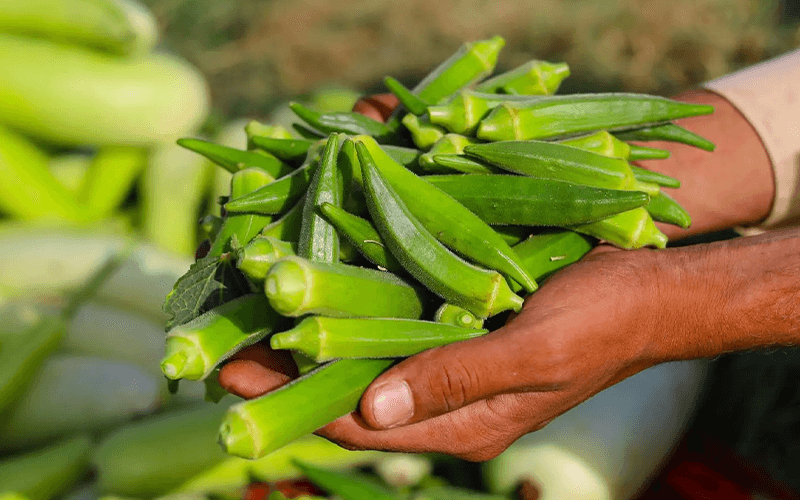
Fresh Okra Exporter from India Sardar Market
Fresh okra (Abelmoschus esculentus) known as Lady’s Finger in many markets and Bhindi at home is one of the most reliable staples in the global fresh produce trade. Whether it is gumbo in the United States, stir-fry in Southeast Asia, or a staple of South Asian kitchens from the Gulf to London, demand is consistent, year-round and growing. India is the world’s largest producer of okra and one of its leading exporters, so no other country can match our combination of volume, price and availability.
Based in Surat, Gujarat, Sardar Market is an established Indian exporter, wholesaler and supplier of fresh vegetables. We run the full supply chain ourselves farm-direct procurement from India’s leading okra belts, strict tender-pod grading, forced-air pre-cooling, and refrigerated delivery at your port. There is a good reason we call Gujarat home: it is now India’s number one okra-producing state, which puts our packing house right in the middle of the country’s most important crop.
Why India’s Okra Export Market Is Worth Your Attention in 2026
Okra is a high-turnover vegetable with a short, exacting cold chain. Get the handling right and it is a dependable, repeat-order commodity. Here is why India is the right source, and why we are the right partner.
- Production power: India is the world’s largest okra producer, harvesting roughly 7.3 million tonnes in 2024 (FAOSTAT) about 60–70% of global output and comfortably ahead of Nigeria, the next-largest grower. That scale means we can source premium pods in every month of the year.
- Export reality: India is among the world’s top ten okra exporters, shipping about 111,000 tonnes of fresh okra worth around US$88 million in 2024 under HS Code 070999 (UN Comtrade / Tridge).
- Where our okra goes today: The United Kingdom is our largest market by value (about US$21 million in 2024), driven by a large South Asian and African diaspora. The UAE is our biggest volume destination at roughly 21,000 tonnes a year, with Singapore, Qatar and Kuwait completing the top five.
- Where the growth is: The world’s biggest okra importers are the USA (about 19% of global imports), Hong Kong (15%) and the Netherlands (10%). Germany’s imports are on the rise with a growing preference for supplies from Ghana and India over Honduras, and steady demand from Canada and North America is supporting export volumes.
- Market outlook: India holds about a 5% share of the UK import basket, where Indian okra commands a premium over the UK market average evidence that a documented, residue-clean chain wins the high-value buyers.
- Our strategy: We focus on the two segments that reward quality premium, residue-tested okra for the UK and European markets, and dependable volume for the Gulf. Because Gujarat is now India’s top okra-producing state, we source the majority of our export-grade pods close to home, keeping our cold chain short and our prices honest.
Our Sourcing Network & Harvesting Seasons
Okra is a fast crop pods are ready roughly 45 to 55 days after sowing and are picked every two to three days once fruiting starts. By sourcing across several states with different growing windows, we keep supply continuous all year.
Strategic Sourcing Clusters
Our procurement teams work directly with farmers and farmer producer organisations (FPOs) across India’s leading okra belts:
- Gujarat (our home base): India’s number one okra-producing state, with about 1.17 million tonnes grown on roughly 94,000 hectares in 2023-24. The Saurashtra-Kutch belt is the standout region it produced close to 1.5 lakh tonnes in 2024-25 with among the highest yields in the country. Sourcing here means the shortest possible haul to Mundra and Nhava Sheva.
- Madhya Pradesh & West Bengal: Two of the country’s other top producers. MP’s Indore belt is a proven export cluster APEDA has facilitated okra and bitter gourd shipments from Indore to Dubai while Bengal adds strong eastern volume in the monsoon window.
- Bihar & Odisha: High-yielding belts that deliver tender pods during the kharif season, when northern and western supplies thin out.
- Andhra Pradesh & Tamil Nadu: Southern clusters that carry the winter (rabi) crop and help balance supply through the regional monsoon shifts.
- Maharashtra: Close to Nhava Sheva port, adding flexibility for last-minute westbound orders.
Year-Round Sowing & Harvesting Calendar
By balancing regions and seasons, we maintain commercial supply almost every month of the year:
| Sourcing Cluster | Peak Supply Window | Notes |
| Gujarat (Saurashtra–Kutch and central Gujarat) | March – July | Main summer crop; India’s largest producing state |
| Madhya Pradesh (Indore belt) | April – June / August – October | Summer and kharif windows; proven export cluster |
| West Bengal | June – October | Strong monsoon-window volume |
| Bihar & Odisha | July – October | Kharif supply when western belts thin out |
| Andhra Pradesh & Tamil Nadu | November – February | Rabi-season southern supply |
| Maharashtra | May – September | Flexible west-region volume near Nhava Sheva |
These are indicative peak windows. Because okra is a warm-season crop grown in overlapping regional seasons, we can maintain commercial supply across most of the calendar year.
Indian Okra Varieties We Supply
We select cultivars for the qualities that matter in export: tender, straight, waxy pods that stay green and snap-crisp on long routes. These are the varieties we ship most often.
1. Arka Anamika (Premium Green Variety)
Our primary export variety, developed by the Indian Institute of Horticultural Research (IIHR). Arka Anamika produces spineless, waxy, lush green pods with five to six ridges, good resistance to Yellow Vein Mosaic Virus (YVMV), and a tenderness that holds well in transit it stays tender instead of turning woody or fibrous.
2. Parbhani Kranti
A highly popular cultivar with smooth, dark green, medium-long pods and excellent keeping quality. Its tolerance to YVMV and consistent field performance make it a dependable choice for container ocean freight.
3. Pusa Sawani
A traditional, widely grown IARI variety producing smooth, dark green, five-ridged pods. It performs well across varied soil types and seasons, which makes it a reliable workhorse for steady volume programmes.
4. Punjab Padmini & Pusa Makhmali
Punjab Padmini yields dark green, waxy, five-ridged pods that stay tender for an extended window, while Pusa Makhmali produces attractive, slender, light green pods preferred by select regional buyers. Both are strong options for supermarket-grade lines.
5. Premium Red Okra (Kumkum Bhindi)
Our specialty offering. Red okra is a nutrient-dense variety with deep red to purple pods and a high concentration of antioxidants and anthocyanins. Sourced from contract farms in Madhya Pradesh and packed under strict protocols, it is a high-margin line for gourmet, organic and speciality retail buyers.
Technical Specifications & Quality Standards
Every consignment we pack is graded against strict physical parameters to comply with global phytosanitary and retail standards.
Our B2B Quality Parameters
| Parameter | Specification |
| Size (pod length) – Small / Tender | 5 cm – 7 cm (highly preferred by retail chains and UK/EU markets) |
| Size (pod length) – Medium (Standard Export Grade) | 7 cm – 10 cm (preferred by GCC and Southeast Asian buyers) |
| Size (pod length) – Large | 10 cm – 14 cm (used primarily for processing or specific regional cuisines) |
| Pod appearance | Straight, tender, waxy and snap-crisp; pods must snap cleanly at the tip, with the tip intact and free from fibre |
| Colour index | Uniform deep green (or dark red/purple for Red Okra); no yellowing, discolouration or wind-rub black scars |
| Defect tolerance | Maximum 1.5–2% cumulative tolerance for minor cosmetic marks or slight shape curvature; zero tolerance for insect bores, mould, decay, yellowing or woody fibre |
| Maximum Residue Limits (MRLs) | Okra is a residue-sensitive crop and a common target of border inspections; every batch is sampled and tested at APEDA-accredited / NABL laboratories before shipment, in compliance with each destination country’s limits |
Exact tolerances are set in the contract or specification sheet for each shipment and confirmed before packing.
Our Post-Harvest Handling & Packaging Process
Okra is one of the most perishable vegetables in the fresh produce trade it has an extremely high respiration rate, and careless handling shows up fast as yellowing, blackened ridges and rot. Our packing house follows a disciplined process from the moment the pods are cut.
Our Quality Assurance Steps
- Early Morning Harvest: Pods are hand-picked in the cool early hours to keep field heat low. Only tender pods of the right length are cut over-mature pods turn woody and fibrous.
- Sorting & Trimming: Pods are sorted by size, length and tenderness, and the stalks are trimmed neatly.
- Kept Dry: We do not wash okra before packing unless drying is fully guaranteed. Water trapped between pods triggers rapid decay and slime development during shipping, so pods are packed dry.
- Forced-Air Pre-Cooling: Packed boxes are pre-cooled to 10°C to 12°C within six hours of harvest. This removes field heat and slows respiration dramatically.
- B2B Packaging: Pre-cooled okra is packed into ventilated export packaging to prevent heat accumulation.
Important: Skipping pre-cooling and loading warm okra into a reefer is the fastest way to lose a shipment. Warm pods raise the container temperature, condensation forms, and the okra decays and turns slimy within days. We never load warm.
Packaging Specifications
To prevent mechanical injury and ensure airflow, we offer:
| Format | Detail |
| Ventilated CFB cartons | 4 kg, 5 kg and 10 kg net weights; printed with your brand and import details |
| Rigid plastic crates | 12 kg and 15 kg crates for regional and short-sea routes |
Branded cartons and crates with your logo and import details are available on request.
Cold Chain Logistics & Shipping Safety
Okra is highly chilling-sensitive it is a warm-climate crop and suffers permanent damage if stored too cold. The set point is warmer than our leafy greens, and the discipline around it matters even more.
Reefer Container Parameters
For ocean shipping, we use refrigerated (reefer) containers set to these exact parameters:
| Parameter | Setting |
| Set point | +10°C to +12°C |
| Relative humidity | 90–95% |
| Fresh air exchange | Moderate; enough to vent respiratory heat without drying the pods |
| Ventilation | Ventilated packaging to prevent heat accumulation |
| Temperature maintained | +10°C to +12°C throughout the voyage |
Warning: Below about +10°C such as a standard 4°C or 0°C setting okra suffers chilling injury: watery spots, surface pitting, blackening of the ridges, and rapid decay once removed from the cold chain. Above +13°C, respiration speeds up and pods yellow, shrivel and rot. We hold the sweet spot between.
Temperature Data Loggers
Independent digital temperature loggers inside every container record temperature and humidity at hourly intervals for the whole voyage. The log is documented proof of the cold chain and the primary evidence for insurance claims or shipping-line compensation in the rare event of equipment failure.
Transit Times From Our Ports
From Mundra or Nhava Sheva, expect roughly 5–7 days to Gulf ports such as Jebel Ali (Dubai), around 8–10 days to Singapore and Southeast Asia, and 16–19 days to the UK. Because okra has a short shelf life, we ship premium UK and EU orders by air freight from Mumbai wherever the timing demands it. Actual transit times vary with the carrier’s schedule and routing.
Export Compliance & Certifications
We handle customs clearance and export compliance in India so your shipment arrives without surprises.
Essential Documentation Checklist
Every okra shipment ships with a full document set:
- Import Export Code (IEC): Issued by the Directorate General of Foreign Trade (DGFT).
- APEDA Registration (RCMC): Registration-cum-Membership with APEDA, required for fresh vegetable exports.
- FSSAI License: Food Safety and Standards Authority of India registration.
- Phytosanitary Certificate: Issued by the Directorate of Plant Protection, Quarantine & Storage (DPPQS), confirming the consignment is free of quarantine pests.
- Residue Test Reports: From APEDA-accredited / NABL laboratories, confirming MRL compliance for the destination country.
- SGS / Intertek Quality Report: Pre-shipment inspection and residue analysis upon buyer request.
- Certificate of Origin: Required to claim preferential tariff benefits essential under the India-UK trade agreement in force since July 2026.
- Commercial Invoice & Packing List: Fully itemised commercial documents.
- Bill of Lading (B/L) / Airway Bill: The contract of carriage for the shipment.
Note on 2026 tariff code alignment: Following the DGFT’s July 2026 harmonisation of the ITC(HS) 2022 Schedule with the Finance Act 2026 (Notifications No. 24/2026-27 for the import policy schedule and No. 26/2026-27 for the export policy schedule), exporters should always confirm the precise 8-digit tariff item in the current ITC(HS) schedule before filing. Fresh okra continues to be classified under heading 0709 (ITC-HS 07099930).
Our Secure B2B Payment Terms & Policy
We operate on secure, documented payment methods only. We do not export on credit, consignment or commission.
The Risks of Consignment/Credit Trade
Operating on consignment common in GCC wholesale markets exposes a supplier to delayed payments, heavy deductions and arbitrary price reductions based on alleged cargo damage. We avoid this exposure entirely by insisting on secure payment structures.
Accepted Payment Structures
- 30% Advance + 70% Against Shipping Documents: A 30% advance (T/T) to begin harvesting and packing, with the balance paid against scanned copies of the Bill of Lading and shipping documents.
- Confirmed, Irrevocable Letter of Credit (L/C) at Sight: Accepted for contract-based, high-volume shipment programmes.
Why Partner with Sardar Market for Indian Okra Sourcing?
Choosing us as your B2B okra supplier means working with a team that handles the whole chain:
- Farm-direct sourcing from India’s leading okra belts, including Gujarat, Madhya Pradesh and West Bengal.
- Strict pod-size, tenderness and colour grading against your specification sheet.
- A certified +10°C to +12°C cold chain from forced-air pre-cooling to discharge at your port.
- Documented residue testing and full farm-to-packhouse traceability.
- Complete export documentation and customs clearance handled in India.
- Secure, documented payment terms no credit, consignment or commission risk.
- Customised FOB or CIF quotes delivered within 24 hours.
Market Trends Reshaping Okra Trade in 2026
1. The India-UK Trade Agreement Is Now Live
The India-UK Comprehensive Economic and Trade Agreement (CETA), signed in London on 24 July 2025, entered into force on 15 July 2026. The UK has removed duties on roughly 99% of Indian tariff lines, including fresh vegetables the ~2% tariff that previously applied to okra is being removed. This matters enormously for okra: the UK is already our largest market by value (about US$21 million in 2024), and APEDA’s market intelligence notes the deal can strengthen India’s position in the UK import basket.
2. The Gulf Keeps Buying Volume
India already supplies the UAE and Gulf states under the India-UAE CEPA (in force since May 2022), and the UAE is our largest okra volume destination at roughly 21,000 tonnes a year. An India-GCC Free Trade Agreement covering Saudi Arabia, Qatar, Kuwait, Oman and Bahrain is under active negotiation, with a target conclusion in 2026 which would further ease access to the biggest volume market for Indian okra.
3. Asia’s Fast-Growing Appetite
Hong Kong is the world’s second-largest okra import market, taking about 15% of global imports, and its imports have been growing at a CAGR of roughly 4% (2019–2024). Singapore is already a top-five destination for Indian okra, and for ASEAN markets small, frequent, residue-certified shipments are the winning formula we regularly run air-freight programmes for exactly this segment.
4. Diversifying Away From a Single Market
Indian agri-exports grew 2.3% year-on-year in 2025-26 to about US$53.1 billion, despite US tariff measures between August 2025 and February 2026. Fresh fruit and vegetable exports continued to perform, with Bangladesh, the UAE, Malaysia, Nepal and Sri Lanka leading the fresh vegetable list evidence that India’s market base keeps broadening.
5. The Road to US$100 Billion
India has set an ambitious target of US$100 billion in agricultural exports by 2030 (with APEDA targeting US$55 billion of that). Fresh okra sits squarely within this push, supported by RoDTEP incentives, Duty Drawback and government assistance for pack houses, pre-cooling units and cold chains all of which keep our FOB and CIF pricing competitive for buyers.
Place Your Wholesale Order with India’s Trusted Okra Supplier
Whether you run a supermarket chain, wholesale market or food-processing unit, Sardar Market offers a reliable, high-quality supply of fresh Indian okra at competitive prices. From farm-direct sourcing in Gujarat and beyond to certified +10°C cold-chain delivery at your port, we make okra exports simple.
Request a Wholesale Quote today. Our B2B export desk will provide customised FOB or CIF pricing for your port within 24 hours.
Frequently Asked Questions (B2B Okra Export)
Q1. What is the HS Code for exporting fresh okra from India?
Fresh okra (Lady’s Finger / Bhindi) is exported under HS Code 07099930, falling under the 6-digit heading 0709 other vegetables, fresh or chilled.
Q2. What is your Minimum Order Quantity (MOQ) for okra shipments?
Our standard MOQ for ocean freight is one 20-foot or 40-foot refrigerated (reefer) container. A 40-ft reefer carries roughly 10 to 12 metric tonnes of fresh okra depending on packaging, and a 20-ft reefer about 5 to 6 tonnes. For air-freight orders, we accept smaller custom volumes.
Q3. Why is pre-cooling okra to 10°C-12°C critical before shipping?
Okra has an extremely high respiration rate. Pre-cooling to 10°C-12°C drops its metabolic rate, preventing the pods from yellowing, turning fibrous or rotting. Warm-loaded okra generates condensation inside the box and decays within a few days.
Q4. Why don’t you ship okra at the same low temperatures as cabbage or cauliflower?
Because okra is highly chilling-sensitive. Below about 10°C it suffers chilling injury watery spots, blackening of the ridges and rapid decay on removal from the cold chain. Okra needs a warmer set point of 10°C-12°C, unlike 0°C crops.
Q5. How long does fresh okra stay fresh under reefer transit?
With a strict 10°C-12°C cold chain and 90-95% relative humidity, export-grade okra keeps for roughly 7 to 10 days comfortably enough for the Gulf (5-7 days) and Singapore routes. For the longer UK and EU routes we use air freight for premium, short-shelf-life orders.
Q6. Can we customise the weight and printing of the okra cartons?
Yes. We supply fully customised, ventilated CFB cartons (4 kg, 5 kg, 10 kg) printed with your brand name, logo and import details, plus rigid 12 kg and 15 kg plastic crates for regional routes.
Q7. Do you export okra on a commission or credit basis to Dubai or Malaysia?
No. We do not export on a commission, consignment or credit basis. Every shipment runs on secure advance T/T or an irrevocable L/C at sight.
Q8. What is Red Okra, and what are its advantages?
Red Okra (Kumkum Bhindi) is a premium purple/red variety sourced from contract farms in Madhya Pradesh. It is valued in organic and gourmet markets for its high antioxidant and anthocyanin content, offering B2B buyers a high-margin specialty product.
Q9. What document verifies that the okra is free of quarantine pests?
Every shipment is inspected by plant quarantine officials in India, who issue a Phytosanitary Certificate verifying the cargo is free of quarantine pests.
Q10. How do we get a CIF price quote for our target port?
Contact our export desk with your destination port, required variety (green or red), size grade, packaging type and delivery schedule. We will send a detailed CIF quote within 24 hours.