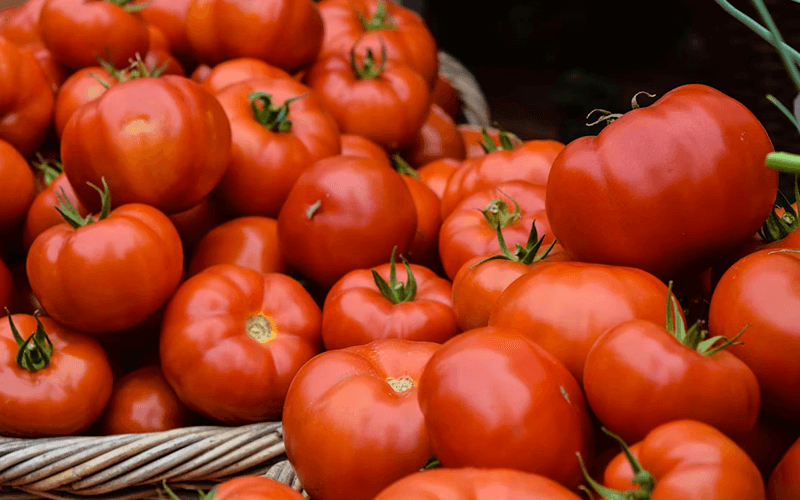
Fresh Tomato Exporter from India Sardar Market
Tomato (Solanum lycopersicum) is the world’s most widely traded fresh vegetable, and India is its second-largest producer, harvesting more than 21 million tonnes a year. Yet India exports less than 1% of the tomatoes it grows which means the world’s importers have barely scratched the surface of what is one of the most abundant, price-competitive and seasonally consistent supplies anywhere on earth. For B2B buyers from Gulf supermarket chains to UK importers, processing plants and restaurant suppliers that is an opportunity: firm, well-graded tomatoes sourced at scale, every month of the year.
Based in Surat, Gujarat, Sardar Market is an established Indian exporter, wholesaler and supplier of fresh vegetables. We run the whole chain ourselves farm-direct procurement from India’s leading tomato belts, strict size, colour and ripening-stage grading, forced-air pre-cooling, and refrigerated delivery at your port. Gujarat’s own Kheda-Anand belt grows substantial tomato volumes right on our doorstep, and we sit a short haul from Mundra and Nhava Sheva, two of India’s busiest container ports.
Why India’s Tomato Export Market Is Worth Your Attention in 2026
Tomato is the most price-volatile fresh vegetable in India which is exactly why buyers who can lock in a consistent, contract-graded supply have the advantage. Here is why India, and our sourcing network in particular, is the right place to buy:
- Volume without limits: As the world’s second-largest tomato producer, India can commit consistent export quantities across every season.
- Three seasons, year-round availability: Kharif, rabi and summer crops across India’s regions keep tomatoes available in every month of the year.
- Competitive FOB and CIF pricing: High production volumes and a short haul to western ports keep freight and landed costs low.
- Zero UK duty from 2026: The India-UK trade agreement, in force since 15 July 2026, removes duties on fresh vegetables.
- A compliance-ready chain: Documented residue testing, phytosanitary certification and farm-to-packhouse traceability open the Gulf, UK and Southeast Asian markets.
Our Sourcing Network & Harvesting Seasons
India grows tomatoes across three distinct seasons kharif (June to November), rabi (October to March) and summer (February to May) in different regions at different times. We build a true year-round calendar by sourcing across several states, so our buyers never face a lean month.
Strategic Sourcing Clusters
Our procurement teams work directly with farmers and farmer producer organisations (FPOs) across India’s leading tomato-growing regions:
- Madhya Pradesh: In recent years the state has led India’s tomato production, with the largest area under the crop (over 15% of the national total). Our network covers the Chhindwara, Shivpuri, Raisen and Shajapur districts, whose well-established mandis (including Chhindwara, Mhow and Shivpuri’s Kolaras and Pohri) feed steady rabi-season volumes.
- Andhra Pradesh: The Madanapalle belt (Annamayya district) has historically been described as Asia’s largest tomato cultivation belt, covering roughly 25,000 hectares and selling several thousand tonnes a day at its peak. We also source from Kurnool, Anantapur and Kadapa. Gluts here have repeatedly shown why export market access matters.
- Karnataka: The Kolar and Chikkaballapur districts host one of India’s largest tomato markets Kolar is often ranked second only to Dharmapuri in South Asia giving us a reliable October-to-February peak source.
- Maharashtra: The Nashik belt, centred on the Pimpalgaon Baswant market one of the largest tomato mandis in India plus Pune and Nagpur supply heavy rabi and summer volumes close to Nhava Sheva (JNPT) port.
- Telangana & Tamil Nadu: The Warangal, Medak and Ranga Reddy belts of Telangana, and the Dharmapuri belt of Tamil Nadu reputed to host Asia’s second-largest tomato market round out our southern supply.
- Gujarat (our home base): The Kheda-Anand belt is Gujarat’s most important tomato area, with Anand ranked the state’s leading tomato-producing district. Sourcing here means fresher produce and the shortest possible haul to Mundra and Nhava Sheva.
Year-Round Sowing & Harvesting Calendar
By balancing regions and seasons, we maintain commercial supply every month of the year. The table below shows the typical peak supply windows for each sourcing cluster.
| Sourcing Cluster | Peak Supply Window | Notes |
| Madhya Pradesh (Chhindwara, Shivpuri, Raisen, Shajapur) | November – February | Rabi peak; large area under crop |
| Andhra Pradesh (Madanapalle, Kurnool, Anantapur, Kadapa) | November – April | Largest-volume southern source |
| Karnataka (Kolar, Chikkaballapur) | October – February | Big South Asia tomato market |
| Maharashtra (Nashik, Pune, Nagpur) | December – March | Rabi peak; summer crop follows |
| Telangana (Warangal, Medak, Rangareddy) | October – February | Southern rabi supply |
| Tamil Nadu (Dharmapuri) | February – May | Summer-window supply |
| Gujarat (Kheda-Anand) | October – February | Home-base rabi supply; shortest port haul |
These are indicative peak windows. Because India grows tomatoes in overlapping seasons across regions, we cover gaps between windows through inter-seasonal production giving buyers commercial supply across all 12 months. National peaks (November to February) also coincide with India’s lowest domestic prices.
Premium Tomato Varieties We Supply
We supply both table tomatoes for fresh retail and processing-grade fruit for paste, sauce and canning, graded precisely to your specification sheet.
1. Arka Rakshak (Premium Transit Hybrid)
Our primary export product. Arka Rakshak is an F1 hybrid developed by ICAR-IIHR (Indian Institute of Horticultural Research, Bengaluru) with triple disease resistance to Tomato Leaf Curl Virus, bacterial wilt and early blight. It produces firm, uniform fruits of 90–100 g with excellent keeping quality, making it our default choice for long ocean voyages.
2. Roma Tomatoes (Processing Grade)
The classic plum-shaped processing tomato thick-walled, meaty, with fewer seeds and low juice content, which gives a high solids yield for paste and sauce. For food-processing buyers who want a specific solids-to-weight ratio, Roma is the standard.
3. Pusa Ruby
One of India’s best-known open-pollinated varieties, developed by IARI (Indian Agricultural Research Institute). Pusa Ruby produces medium, roundish fruits with a good balance of yield and adaptability across India’s regions a dependable choice for budget-conscious retail markets.
4. Pusa Rohini
A popular IARI variety prized for its early maturity roughly 80 days to first harvest and high yield (commonly around 41 tonnes per hectare). Early arrival in the season lets it catch premium prices at the start of the marketing window.
5. Arka Vikas
An IIHR open-pollinated variety producing medium-to-large fruits (80–90 g) with a typical yield of around 35 tonnes per hectare. A proven mid-market table tomato suited to regional retail chains.
6. Arka Alok & Arka Meghali
Arka Alok bears large fruits (about 120 g) with resistance to bacterial wilt and a potential yield of around 46 tonnes per hectare. Arka Meghali is bred for rainfed, kharif-season cultivation, with medium fruits (about 65 g) and strong field tolerance an ideal choice for the monsoon window when supply is tightest.
Technical Specifications & Quality Standards
Every fruit we ship is graded against international trade standards at our packing facility. Here are the parameters we work to:
Our B2B Quality Parameters
| Parameter | Specification |
| Variety | Arka Rakshak, Roma, Pusa Ruby, Pusa Rohini, Arka Vikas or a specified cultivar |
| Ripening stage | Breaker / turning (10–30% colour change) for sea freight; pink to light red for air freight |
| Size / diameter grading | Uniform per order; e.g. 45–55 mm, 55–65 mm or 65–75 mm |
| Colour | Uniform red; no green shoulders or yellowing |
| Firmness | Firm; no soft spots or bruising |
| Brix (total soluble solids) | Confirmed per contract; typically 4.0–5.5% for table-grade fruit |
| Blemish / damage tolerance | Typically up to 3–5% by weight |
| Foreign matter | None |
| Free moisture | None in pack |
| Residue compliance | Meets destination-country MRLs; lab reports supplied |
| Shelf life at +10°C to +13°C | 2–4 weeks from pre-cooling |
Exact tolerances are set in the contract or specification sheet for each shipment and confirmed before packing.
Our Post-Harvest Handling & Packaging Process
Tomato quality is decided in the first hours after harvest. Fruit picked for export is harvested at the breaker-to-turning stage (10–30% colour change) so it ripens on the voyage and lands at the exact ripeness your market wants. Our packing house follows a disciplined process from the moment the fruit is picked.
Our Quality Assurance Steps
- Early Morning Harvest: Fruit is hand-picked at the breaker/turning stage in the cool early hours to keep field heat low. We harvest only firm, uniformly sized fruit overripe fruit cannot be revived in transit.
- Hydrocooling & Washing: Tomatoes are washed in cold, chlorinated water to remove field dirt and surface spores, then dried with high-velocity air dryers so no free moisture is packed.
- Grading & Size Selection: Fruit is sorted by variety, size, colour and firmness to give you a uniform, retail-ready grade.
- Forced-Air Pre-Cooling: Packed cartons are placed in our pre-cooling chambers for several hours to bring the core temperature down to +10°C to +13°C before loading.
- Export Boxing: Pre-cooled cartons are strapped and palletised, with temperature data loggers placed inside before the container is sealed.
Important: Skipping pre-cooling and loading warm tomatoes into a reefer accelerates ripening in transit, so the cargo arrives overripe, soft and bruised. Warm fruit also raises the container temperature and drives condensation. We never load warm.
Export Packaging Specifications
We customise packaging to your market’s conventions. Standard options include:
| Specification | Detail |
| Carton | 5-ply corrugated fibreboard, ventilated / perforated |
| Liner | Food-grade LDPE inner liner |
| Common net weights | 5 kg, 10 kg and 15 kg (custom weights on request) |
| Palletisation | Standard 20-ft and 40-ft reefer pallet patterns |
| Loading capacity (40-ft reefer) | Approximately 20–22 metric tonnes net |
| Labelling | Product, variety, net weight, packhouse UIC and traceability details |
Loading capacity varies with carton weight and container configuration; final counts are confirmed per booking.
Cold Chain Logistics & Shipping Safety
Tomato is a warm-climate fruit with a narrow safe temperature window. Mature-green and turning fruit are damaged by chilling below roughly +10°C, yet ripen too fast above +13°C so the entire chain runs between +10°C and +13°C, and disciplined temperature control is everything.
Reefer Container Parameters
We ship in refrigerated (reefer) containers set to these parameters:
| Parameter | Setting |
| Set point | +12°C to +13°C |
| Relative humidity | 90–95% |
| Fresh air exchange | Moderate (approx. 25–40 m³/hour) |
| Ethylene management | Continuous purge tomatoes are ethylene-producing fruit |
| Temperature maintained | +10°C to +13°C throughout the voyage |
Warning: Below roughly +10°C, mature-green and turning tomatoes risk chilling injury pitting, water-soaked spots and failure to ripen properly on arrival. Above +13°C, ripening races ahead and fruit can arrive overripe, soft and bruised. We hold the chain between +10°C and +13°C from pre-cooling to discharge.
Temperature Data Loggers
Independent digital temperature loggers inside every container record ambient temperature and humidity at hourly intervals throughout the voyage. The log is documented proof of the cold chain and the primary evidence for insurance claims or shipping-line compensation in the rare event of equipment failure.
Visual Audit & Container Seal Process
We photograph and record the full loading process container interior, pre-cooled cartons, loading arrangement, data logger placement and the final door seal and send the records to you before the vessel sails.
Transit Times From Our Ports
From Mundra or Nhava Sheva, expect roughly 4–7 days to Gulf ports such as Jebel Ali (Dubai), 3–5 days to Colombo, and around 16–19 days to the UK, with onward connections to Southeast Asia and East Africa. For premium, short-shelf-life orders we also ship by air freight from Mumbai. Actual transit times vary with the carrier’s schedule and routing.
Export Compliance & Certifications
We handle customs clearance and export compliance in India so your shipment arrives without surprises.
Essential Documentation Checklist
Every tomato shipment ships with a full document set:
- Import Export Code (IEC): Issued by the Directorate General of Foreign Trade (DGFT).
- APEDA Registration (RCMC): Registration-cum-Membership with APEDA, required for fresh vegetable exports.
- FSSAI License: Food Safety and Standards Authority of India registration.
- Phytosanitary Certificate: Issued by the Directorate of Plant Protection, Quarantine & Storage (DPPQS), confirming the consignment is free of quarantine pests notably Tuta absoluta (South American tomato leaf miner), the key quarantine pest watched by tomato-importing countries.
- Residue Test Reports: From APEDA-accredited / NABL laboratories, confirming MRL compliance for the destination country.
- SGS / Bureau Veritas / Intertek Inspection Report: Pre-shipment inspection and residue analysis upon buyer request.
- Certificate of Origin: Required to claim preferential tariff benefits essential under the India-UK trade agreement in force since July 2026.
- Commercial Invoice & Packing List: Fully itemised commercial documents.
- Bill of Lading (B/L) / Airway Bill: The contract of carriage for the shipment.
- Fumigation Certificate / ISPM-15 Compliance: Applied where wooden pallets are used, in line with international plant-protection standards.
Note on 2026 tariff code alignment: Following the DGFT’s July 2026 harmonisation of the ITC(HS) 2022 Schedule with the Finance Act 2026 (Notifications No. 24/2026-27 for the import policy schedule and No. 26/2026-27 for the export policy schedule), exporters should always confirm the precise 8-digit tariff item in the current ITC(HS) schedule before filing. Fresh tomatoes continue to fall under heading 0702 (ITC(HS) 0702 00 00).
Our Secure B2B Payment Terms & Policy
We operate on secure, documented payment methods only. We do not export on credit, consignment or commission.
The Risks of Saturated Commission Markets (e.g., Dubai/UAE)
The Gulf fresh produce market is saturated, and many local agents push commission-based or consignment sales. For an exporter that means delayed settlement, heavy deductions and unfounded damage claims. We avoid this exposure entirely by insisting on secure payment structures.
Accepted Payment Structures
- 30% Advance + 70% Against Shipping Documents: A 30% advance (T/T) to begin harvesting and packing, with the balance paid against scanned copies of the Bill of Lading and shipping documents.
- 50% Advance + 50% Against Shipping Documents: A 50% advance (T/T), with the balance against scanned shipping documents our preferred split for air freight.
- 100% Advance Payment: Available, and recommended for rapid air freight shipments.
- Confirmed, Irrevocable Letter of Credit (L/C) at Sight: Accepted for contract-based, high-volume shipments.
Why Partner with Sardar Market for Indian Tomato Sourcing?
Choosing us as your B2B tomato supplier means working with a team that handles the whole chain:
- Farm-direct sourcing from India’s leading tomato belts, including Gujarat, Madhya Pradesh and Andhra Pradesh.
- Strict size, colour and ripening-stage grading against your specification sheet.
- A certified +10°C to +13°C cold chain from forced-air pre-cooling to discharge at your port.
- Documented residue testing and full farm-to-packhouse traceability.
- Complete export documentation and customs clearance handled in India.
- Secure, documented payment terms no credit, consignment or commission risk.
- Customised FOB or CIF quotes delivered within 24 hours.
Market Trends Reshaping Tomato Trade in 2026
1. The India-UK Trade Agreement Is Now Live
The India-UK Comprehensive Economic and Trade Agreement (CETA), signed on 24 July 2025, entered into force on 15 July 2026. The UK has removed duties on roughly 99% of Indian tariff lines, including fresh vegetables. The UK is already one of the world’s largest tomato importers it imported about 390,000 tonnes of fresh tomatoes worth around US$800 million in 2024 and CETA now makes Indian fruit cheaper to land there.
2. The Gulf Keeps Buying Premium
India already supplies the UAE and Gulf states under the India-UAE CEPA (in force since May 2022). An India-GCC Free Trade Agreement covering Saudi Arabia, Qatar, Kuwait, Oman and Bahrain is under active negotiation, with a target conclusion in 2026 which would further ease access to the biggest volume market for Indian fresh produce.
3. Taming India’s Price Volatility
Tomato is India’s most price-volatile vegetable. The 2023 price shock when wholesale prices at some mandis crossed ₹100 per kg in July 2023 and retail prices hit ₹200+ per kg in several cities was followed by a sharp crash into the new year. For exporters, that volatility is an opportunity: staggered procurement across seasons and contract-linked pricing let us smooth the swings and protect both buyer and farmer.
4. Diversifying Away From a Single Market
Bangladesh and Nepal have long been India’s biggest tomato export destinations by volume, moving overland. By value, the Gulf dominates. Now destinations such as Malaysia and the Maldives are among the fastest-growing markets for Indian fresh vegetables, and overall Indian agri-exports grew 2.3% year-on-year in 2025-26 to about US$53.1 billion despite US tariff measures evidence that India’s market base is broadening.
5. The Road to US$100 Billion
India has set an ambitious target of US$100 billion in agricultural exports by 2030 (with APEDA targeting US$55 billion of that). Fresh vegetables sit squarely within this push, supported by RoDTEP incentives, Duty Drawback and government assistance for pack houses, pre-cooling units and cold chains all of which keep our FOB and CIF pricing competitive for buyers.
Place Your Wholesale Order with India’s Trusted Tomato Supplier
Whether you run a supermarket chain, wholesale market, restaurant group or food-processing unit, Sardar Market offers a reliable, high-quality supply of fresh Indian tomatoes at competitive prices. From farm-direct sourcing in Gujarat, Madhya Pradesh and Andhra Pradesh, to certified +10°C to +13°C cold-chain delivery at your port, we make tomato exports simple.
Request a Wholesale Quote today. Our B2B export desk will provide customised FOB or CIF pricing for your port within 24 hours.
Frequently Asked Questions (B2B Tomato Export)
Q1. What is the HS Code for exporting fresh tomatoes from India?
Fresh tomatoes are classified under HS heading 0702, tariff item 0702 00 00. Processed forms fall under different codes tomato paste and purée under heading 2002, and ketchup and sauces under heading 2103.
Q2. What is your Minimum Order Quantity (MOQ) for fresh tomato exports?
One full container load a 20-ft or 40-ft reefer. A 40-ft reefer carries approximately 20–22 metric tonnes of packed tomatoes depending on carton weight and configuration.
Q3. What payment terms do you accept?
We offer secure, documented structures only typically 30% advance (T/T) with the balance against shipping documents, or a confirmed, irrevocable Letter of Credit (L/C) at sight for larger contract shipments. We do not export on credit or consignment.
Q4. Can you supply tomatoes at specific ripening stages?
Yes. For sea freight we harvest at the breaker-to-turning stage (10–30% colour change) so fruit ripens evenly during transit and lands at the ripeness your market wants. For air freight we supply pink to light-red fruit ready for immediate sale.
Q5. Do you offer third-party quality inspections?
Yes. We welcome pre-shipment inspections by SGS, Bureau Veritas or Intertek at our packing house, and we support independent residue sampling and lab analysis as required.
Q6. How do you guarantee the shelf life of tomatoes during shipping?
By holding a strict +10°C to +13°C cold chain from forced-air pre-cooling to discharge, with continuous ethylene purge in the reefer, ventilated cartons and documented temperature loggers. This routinely gives export-grade fruit a shelf life of 2–4 weeks.
Q7. Are your tomatoes certified for European and Middle Eastern markets?
We source from GlobalGAP-compliant farms where the destination requires it, obtain the phytosanitary certificate for every shipment, comply with destination-country MRL standards, and run HACCP and ISO 22000-aligned systems across our sorting and packing lines.
Q8. Can you provide customised branding and packaging?
Yes. We supply custom-printed, ventilated CFB cartons in net weights of 5 kg, 10 kg or 15 kg (and other sizes on request), with your brand, product details and import information printed on the pack.
Q9. What is the transit time from Indian ports to the Gulf region?
Expect roughly 5–7 days from Mundra or Nhava Sheva to Gulf ports such as Jebel Ali (Dubai). Transit to Colombo is about 3–5 days, and the UK about 16–19 days.
Q10. How do we get a CIF quote for our target port?
Share your destination port, required quantity, packaging preference and arrival window, and our export desk will return a customised CIF (or FOB) quotation within 24 hours.